Image Credit: 光曦 刘 on Unsplash
The name Yunnan is a direct translation of the land south of the clouds, and the moment you arrive, you will understand why. Spanning the southwest corner of China, Yunnan unfolds like a scroll. In a single journey, you can wander through ancient stone alleys, gaze across alpine lakes, marvel at towering karst pillars, and look up at snow-capped Himalayan peaks rising toward the bright blue skies.
For Muslim travelers, Yunnan holds a wonderful surprise. It is not only one of the most visually stunning corners of Asia, but also home to a centuries-old Hui Muslim community. Throughout the province, traditional Chinese-style mosques sit beside neighborhood markets, welcoming prayer spaces are readily accessible, and the aroma of authentic Halal cooking fills the town centers.
Traveling across this mountainous province is surely a one-of-a-kind adventure, provided you prepare well for the terrain. Here is your complete guide to exploring Yunnan from Kunming up to the Tibetan heights of Shangri-La, complete with essential packing guidance, altitude tips, and verified faith-friendly stops.
Preparing for the Highlands: Altitude Readiness and Smart Packing
Because Yunnan rises steadily from south to north, planning your route thoughtfully makes a world of difference for your comfort and health:
Ascend Gradually
Your journey naturally climbs in elevation, starting in Kunming at 1,900 meters (roughly 6,200 feet), continuing to Dali at 2,000 meters, Lijiang at 2,400 meters, and reaching the high alpine plateau of Shangri La at 3,200 meters (over 10,500 feet). Following this south-to-north path gives your body time to adjust naturally.
Preventing Altitude Sickness
Take things slow during your first twenty-four hours at higher elevations. Drink plenty of warm water, skip heavy cardio, and avoid rushing up steep stairs. Portable oxygen canisters are inexpensive and widely available at local pharmacies, train stations, and convenience stores throughout Lijiang and Shangri-La. Many travelers also take hongjingtian (rhodiola root), a traditional herbal supplement available at herbal shops in Kunming, several days before ascending.
Smart Layering
Highland weather changes quickly. Strong sun by midday can give way to sharp mountain chills as soon as dusk arrives. Pack thermal base layers, a fleece sweater, a windproof outer jacket or packable down coat, polarized sunglasses, sunscreen, comfortable walking sneakers with good grip, and a compact travel prayer mat with a pocket compass.
Stop 1: Kunming, The City of Eternal Spring
Your adventure begins in Kunming, the provincial capital affectionately known as the Spring City due to its pleasant, mild climate all year round.
What to See and Do
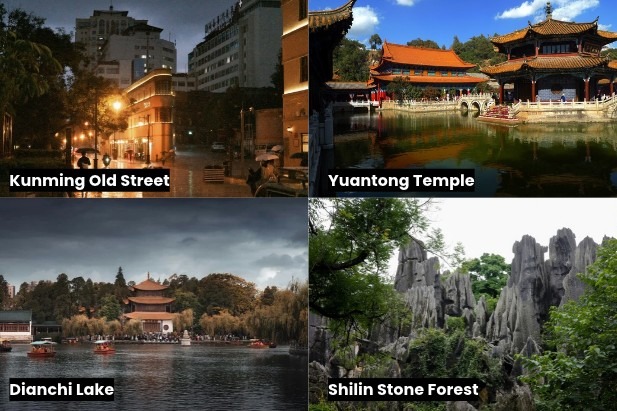
Kunming Old Street: Spend a relaxed morning strolling along historic flagstone pedestrian lanes lined with preserved Qing Dynasty wooden facades, traditional tea houses, and ancient medicine shops.
Yuantong Temple: Nestled at the foot of Yuantong Hill, this complex is more than twelve hundred years old, featuring water courtyards, bridges, and graceful architecture.
Shilin Stone Forest: Located roughly ninety minutes outside the city, this UNESCO World Heritage site is a geological wonder. Wander among towering limestone karst pillars that shoot up from the earth like a petrified forest of stone.
Dianchi Lake: If you visit between late autumn and early spring, head to the lake shores to watch thousands of black-headed Siberian gulls that migrate here annually, sweeping gracefully across the water.
Muslim-Friendly Highlights in Kunming
Kunming is home to the historic Shuncheng Mosque, one of the most prominent Islamic landmarks in southwestern China. Originally founded during the Ming Dynasty, it features classic Chinese courtyard architecture with tiled roofs, carved wooden screens, and a serene atmosphere for your daily prayers.
Right around the mosque, you will find an array of certified Halal dining spots. Do not leave Kunming without tasting the authentic Yunnan crossing-the-bridge noodles (guoqiao mixian). You will be served a large hot bowl of rich chicken broth sealed with a thin layer of aromatic oil, alongside small plates of thinly sliced beef, quail eggs, fresh herbs, and soft rice noodles.
A practical tip for Muslim travelers to find Halal food is to spot these two characters: 清真, which reads as ‘qingzhen’ or ‘Halal’ in Chinese. Most of the restaurants that show this sign will have them with bright green banners.
Stop 2: Dali, Lakeside Breezes and Bai Heritage
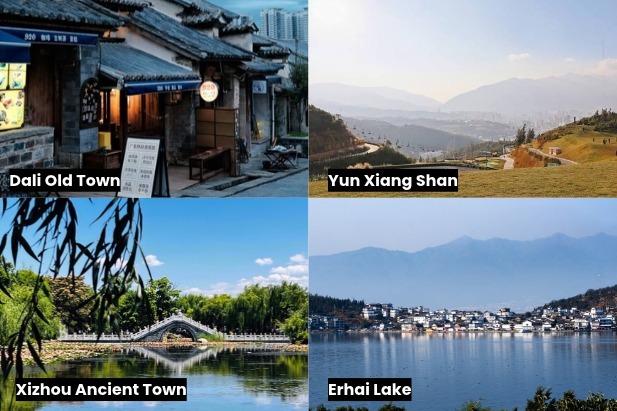
Board a high-speed train westward to Dali, a charming realm tucked between the towering slopes of the Cangshan Mountains and the expanse of Erhai Lake.
What to See and Do
Dali Old Town: Encircled by stone city walls and monumental gate towers, the old town is filled with stone water canals, blossoming gardens, and boutique craft shops.
Yun Xiang Shan: Head up into the hills overlooking Dali for panoramic views of the entire valley, the lake, and the traditional white-walled villages below.
Xizhou Ancient Town: Located just north of Dali, Xizhou offers a deeper look into the culture of the Bai ethnic minority. Walk among preserved courtyard residences featuring ornate eaves, browse the morning farmers market, and watch local artisans practice traditional indigo tie-dye techniques.
Erhai Lake Ecological Corridor: Rent a bicycle or electric scooter to glide along the paved path that hugs the lake, taking in scenic reserves, mountain reflections, and peaceful shoreline cafes.
Muslim-Friendly Highlights in Dali
Dali has a longstanding Hui community. In neighboring districts like Xiaguan and villages surrounding Erhai Lake, local prayer spaces are welcoming and easy to locate.
For meals, seek out traditional Hui family restaurants serving copper pot beef stew, seasoned cold cut beef, and fresh seasonal vegetables seasoned with mountain herbs. Do not miss local flatbreads (baba), freshly baked in street ovens until golden and crisp, perfect for an afternoon energy boost.
Stop 3: Lijiang, Glacial Peaks and Ancient Canyons
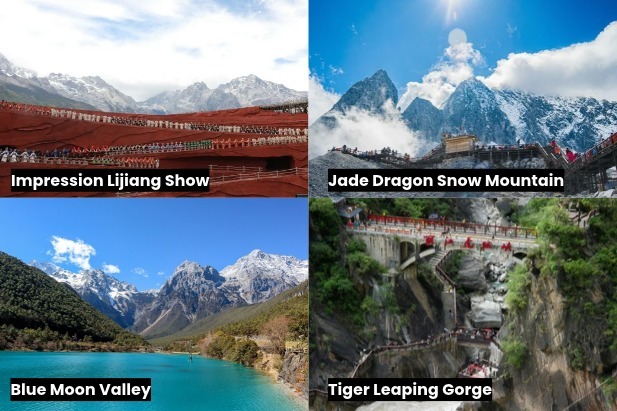
Continuing north, the terrain becomes grander as you enter Lijiang, the homeland of the Naxi people, resting beneath the presence of Jade Dragon Snow Mountain.
What to See and Do
Impression Lijiang Show: Directed by famed filmmaker Zhang Yimou, this open-air cultural performance takes place on a red earth amphitheater at an elevation of 3,100 meters, using the snow-covered peaks of Jade Dragon Snow Mountain as its natural backdrop.
Jade Dragon Snow Mountain and Glacier Park: Take a cable car ride ascending high above the treeline to reach Glacier Park, where you can walk along boardwalks beside alpine glaciers.
Blue Moon Valley: At the base of the mountain lies this dreamlike valley, where glacial meltwater forms a chain of turquoise blue lakes framed by white gravel terraces and lush pine forests.
Tiger Leaping Gorge: Located on the road toward Shangri La, this is one of the deepest river canyons on earth. Walk along the upper cliffside trail as the mighty Jinsha River roars through narrow stone passes hundreds of meters below.
Muslim-Friendly Highlights in Lijiang
While Lijiang Old Town is primarily Naxi, several verified Halal eateries operate within the newer city districts and along major thoroughfares.
After a chilly morning exploring glacial lakes, gather around a simmering Halal beef hotpot. The tender beef simmered with wild highland mushrooms, tender potatoes, and aromatic broth will provide comforting nourishment.
Stop 4: Shangri-La, The Tibetan Plateau
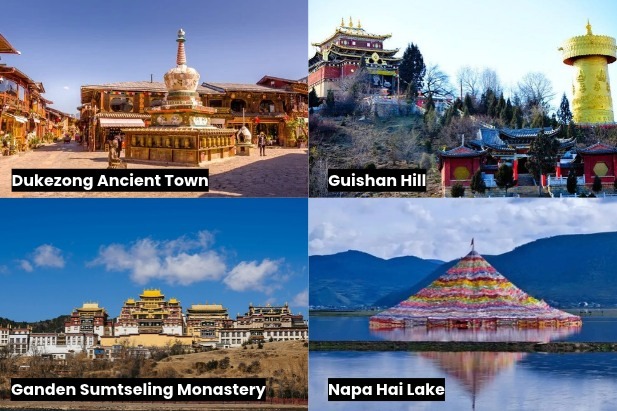
Your final ascent brings you to Shangri-La, formerly known as Zhongdian, where alpine meadows, Tibetan prayer flags, and golden temple roofs welcome you to the roof of Yunnan.
What to See and Do
Dukezong Ancient Town: Known as the city of moonlight, Dukezong is an old trading stop along the Tea Horse Road, filled with traditional Tibetan timber homes, stone-paved alleys, and cozy cafes.
Guishan Hill and the Giant Prayer Wheel: Climb the steps of Guishan Park to reach the Dafo Temple. Here stands a colossal gilded prayer wheel weighing over sixty tons; join hands with fellow travelers from around the world to turn it clockwise in a shared moment of wonder.
Ganden Sumtseling Monastery: Often described as the Little Potala Palace, this seventeenth-century Tibetan Buddhist monastery sits majestically against a hillside, overlooking a seasonal wetland lake that mirrors its golden roofs.
Napa Hai Wetland Lake: Just a short drive northwest of the old town lies Napa Hai (Napa Lake), a seasonal high plateau wetland surrounded by distant mountain ranges. Depending on when you visit, the landscape will change: summer brings broad blue waters with grassy shores, while autumn and winter turn the basin into golden grasslands where black-necked cranes, grazing yaks, and mountain ponies roam freely. Renting an e-bike or hiring a local car to cruise the scenic ring road makes for an invigorating afternoon in nature.
Muslim-Friendly Highlights in Shangri-La
Shangri-La is home to a dedicated local Hui community centered around the Shangri-La Mosque, located within easy walking distance of the central district. The mosque offers a peaceful place for prayers amidst your highland explorations.
Local Halal dining on the plateau focuses on hearty, nourishing meals designed for alpine climates. Enjoy certified Halal Tibetan-style copper pot hotpots filled with tender beef, root vegetables, and hot broth, paired with warm barley bread to fuel your high-altitude walks.
Traveling Yunnan with Reflection and Wonder
Exploring Yunnan from its blooming spring valleys to its windswept Tibetan highlands is a journey of discovery and mindfulness. Seeing the striking harmony between towering natural creations, ancient minority cultures, and enduring Islamic heritage reminds us of the vastness of the world and the beauty of human diversity.
With a well-planned itinerary, proper altitude preparation, and your favorite travel companions, Yunnan offers one of the most fulfilling journeys in Asia.