
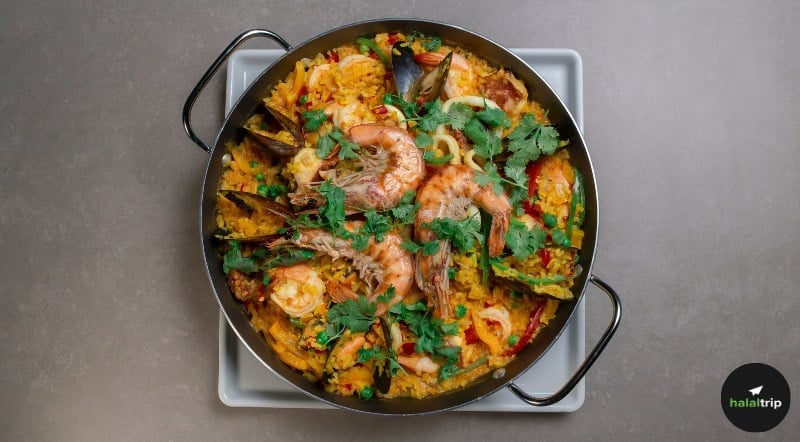
Image Credit: Douglas Lopez on Unsplash
Close your eyes and picture the classic Spanish seaside in the afternoon: a wide iron pan resting over a fire, the amber tint of saffron warming in the pan, and the irresistible scent of rosemary smoke curling through the warm coastal air. Along the edges of the pan, the rice begins to crackle, forming the coveted caramelized crust locals call as socarrat.
Today, paella is heralded worldwide as the quintessential emblem of Spanish gastronomic pride. Travel brochures, tapas bars, and culinary tours from Madrid to Barcelona present it as pure Mediterranean tradition.
Yet peel back the layers of time, and a fascinating, often overlooked truth emerges: this world famous national dish would simply not exist without the vision, botanical knowledge, and hydraulic genius of Muslim civilization in Al Andalus.
To understand paella, one must first ask a fundamental question: how did rice arrive in Spain at all?
Before the eighth century, rice was virtually unknown across the Iberian Peninsula. Wild varieties did not grow naturally in western Europe, and Roman agricultural texts made almost no mention of cultivating it as a staple crop. That changed with the arrival of Arab and Berber settlers, who brought with them agrarian traditions refined across North Africa, Persia, and the Levant.
Recognizing the fertile potential of eastern Spain, Muslim botanists and farmers introduced Asian short grain rice, or Oryza sativa, to the coastal wetlands around Valencia. They found an ideal area in the freshwater lagoon of Albufera, where shallow waters and warm Mediterranean sunshine offered perfect conditions for rice paddies.
The linguistic legacy of this botanical revolution remains woven directly into the Spanish language. The modern Spanish word for rice, arroz, is an unmistakable etymological descendant of the Arabic al ruzz. Every time a chef in Valencia measures out grains for dinner, they are speaking an echo of Islamic heritage.
Rice is a thirsty crop. Planting it in a region characterized by hot and dry summers required something far more complex than seeds. Muslim hydraulic engineers transformed the parched landscape surrounding Valencia into lush orchards and flourishing fields, a fertile belt still known today as la huerta. They accomplished this by designing gravity-fed irrigation canal systems known as acequias, a term rooted directly in the Arabic word as saqiya, meaning the water conduit.
These channels diverted water from the Turia River, guiding it through a labyrinth of stone aqueducts, sluice gates, and water wheels. More importantly, the community established democratic water distribution customs to ensure that every farmer, regardless of property size, received their fair share of water during the dry months.
This Islamic system proved so remarkably efficient that it has survived uninterrupted for more than a thousand years. Even today, every Thursday morning at midday, farmers still gather outside the Apostles Door of Valencia Cathedral for the Tribunal de las Aguas, the Water Tribunal. Recognized by UNESCO as Intangible Cultural Heritage, this oral court resolves agricultural irrigation disputes in the open air, just as Andalusian water magistrates did ten centuries ago.
A true paella is defined as much by its aroma and luminous color as by its texture. That signature golden glow comes from a pinch of crimson threads: saffron.
While wild crocuses existed in parts of the ancient Mediterranean, it was Muslim traders and agronomists in Al Andalus who systematically cultivated the delicate purple Crocus sativus flower across central and eastern Spain, turning regions like La Mancha into the spice capitals of Europe.
Here again, language tells the tale. The Spanish word for saffron, azafrán, traces its roots directly to the Arabic az za'faran.
When blooming autumn fields were harvested, farmers dried the delicate red stigmas to perfume savory broths with a warm, bittersweet earthiness. Paired with aromatic herbs like rosemary and garlic, saffron became the soul of the pan, infusing every grain of short rice with vibrant flavor and an undeniable golden warmth.
Long before paella became a showcase dish in upscale seaside restaurants, it was a humble midday meal cooked outdoors by agricultural laborers, farmhands, and shepherds working the fertile soil of Valencia.
During the harvest, workers took their midday break amidst the orange groves. Over open fires fed by dried orange wood prunings, which lent a delicate citrus aroma to the smoke, they set a wide, shallow, two-handled iron pan.
The original rural recipe looked very different from the modern tourist platters piled high with mussels, prawns, and chorizo. Farmworkers gathered whatever humble ingredients the land provided: short grain rice, local flat green beans known as bajoqueta, large white lima beans called garrofó, fresh garden tomatoes, wild snails, and occasionally chicken or rabbit.
The dining process itself echoed deep communal traditions. Rather than ladling portions onto separate plates, the workers gathered around the steaming pan, each armed with a simple wooden spoon, eating inward from their designated triangle of rice. This practice of shared dining from a common vessel strongly mirrors the communal food culture of Middle Eastern and North African.
There is even a charming piece of local folkloric wordplay that Valencians love to recount. While the linguistic origin of the word paella stems from the Latin word for pan, patella, an enduring romantic legend suggests the name evolved from the Arabic baqiya, meaning leftovers, referencing dishes lovingly prepared by gathering the remaining harvests and meats of community banquets.
Food possesses a remarkable ability to hold memories long after dynasties fall and political borders shift. While political changes eventually altered the religious landscape of Spain after 1492, the culinary and agricultural foundations laid during centuries of Islamic rule could never be erased.
Every bubbling pan of authentic paella prepared along the Mediterranean today is a living testament to that enduring shared history. From the short grains cultivated in the marshes of Albufera and the crystal streams flowing through ancient acequia canals, to the golden kiss of saffron threads, the soul of paella remains inseparable from the heritage of Al Andalus.
It stands as a delicious reminder that cultures do not simply clash; they learn from each other, enrich one another, and leave behind timeless gifts for the entire world to savor.

