
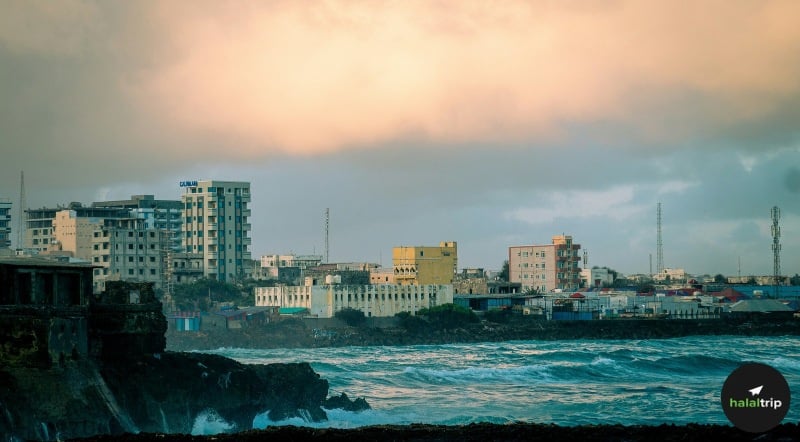
Image Credit: Abdalla Emiir on Unsplash
Long before steam engines churned the oceans and modern borders divided continents, the western Indian Ocean was not a barrier, but a vast highway. Along this maritime road, wooden ships traveled back and forth for centuries, guided by the seasonal monsoon winds.
This coastal strip, stretching from southern Somalia through Kenya and Tanzania down to Mozambique, is known as the Swahili Coast. Its history is a remarkable testament to what happens when commerce, faith, and mutual respect meet. Driven by trade and bound by spiritual kinship, Arab and Persian seafarers crossed the open seas, helping weave an African Islamic civilization that still thrives today.
To understand the history of this coast, one must first understand the wind. Life here has always moved to the rhythm of two seasonal monsoons: the Kaskazi and the Kusi.
From November to March, the northeast monsoon, known as the Kaskazi, blew steadily from the Arabian Sea, filling the triangular sails of merchant dhows departing from Muscat, Aden, Siraf, and Basra. Pushed south along the East African shoreline, these wooden vessels brought dates, rosewater, textiles, glazed Persian pottery, and intricate glass beads.
Once here, however, the sailors could not simply turn around and head home. The ocean currents and winds would not allow it. They had to wait for the arrival of the southwest monsoon, the Kusi, which began in April to push them safely back north.
Because sailors spent months ashore waiting for the seasonal winds to shift, trade in East Africa was never a hurried affair. Merchants rented homes, learned local dialects, and became familiar faces in the markets.
The ships that carried them were marvels of indigenous engineering. Known locally as the mtepe, they were built from planks stitched together with coconut coir rope. This ingenious flexibility allowed hulls to bend and ride gently over crashing surf and shallow coral reefs without shattering.
In exchange for foreign goods, the ports of East Africa provided commodities that shaped the luxury markets of the medieval world. Mangrove poles, prized in arid desert kingdoms for constructing durable ceilings, were stacked into dhow holds alongside aromatic gums, rock crystal, tortoise shell, and refined gold brought from the southern interior through the legendary port of Sofala.
For generations, early colonial historians wrongly claimed that the monumental stone towns of East Africa were foreign outposts founded by outsider colonists. Modern archaeology and African oral history have completely dismantled that myth.
Swahili civilization was, at its heart, a deeply rooted indigenous African culture. The people were Bantu speakers whose ancestors had inhabited the coastal inlets and offshore archipelagos for centuries. What made them extraordinary was their openness: they were skilled maritime traders who welcomed visiting merchants into their communities as partners, neighbors, and kin.
Across the coast, oral traditions still celebrate the memory of the Shirazi. According to historical chronicles, merchant families from Shiraz in southern Persia arrived during the tenth century, seeking trade and peaceful settlement.
Whether this represents a single historic voyage or centuries of migration from the Persian Gulf, the Shirazi heritage became a prestigious cultural identity across Zanzibar, Pemba, and Kilwa. Visiting traders married into prominent local merchant families, cementing alliances that were both commercial and familial.
This blending of worlds gave birth to Kiswahili, one of the most widely spoken and melodic languages in the world today. While remaining firmly Bantu in its grammar and sentence structure, Kiswahili absorbed a treasure trove of Arabic and Persian words. Terms for trade, timekeeping, navigation, faith, and legal agreements flowed naturally into daily speech, creating a language uniquely suited for an interconnected oceanic world.
Unlike many other parts of the world, Islam was not carried into coastal East Africa by marching armies or imperial conquests. It arrived in the luggage of honest merchants. In bustling port markets, local rulers and townspeople observed foreign traders who washed before prayer five times a day, fulfilled their contracts scrupulously, and gave charity to the poor. The universal principles of Islam, emphasizing spiritual equality and commercial integrity, resonated deeply. Over generations, Islam became the spiritual heartbeat of the coastal towns, integrated harmoniously into indigenous social customs.
As coastal communities embraced the faith, they created an architectural style found nowhere else on earth: the coral stone mosque. Builders quarried live coral rag from the ocean floor at low tide. While still soft and moist, the coral could be carved like butter into graceful fluted arches, arched niches, and intricate mihrabs. Left to dry in the coastal sun, it hardened into solid stone, which was then bound with mortar made from burned seashells.
The crowning jewel of this tradition was the Great Mosque of Kilwa, situated on an island off the southern coast of Tanzania. Founded in the tenth century and expanded across dynasties, it stood for centuries as the largest covered mosque in sub-Saharan Africa.
When the famed Moroccan scholar and traveler Ibn Battuta visited Kilwa in 1331, he was mesmerized by its grandeur, describing it as one of the most beautiful and well-constructed cities he had ever seen.
Further north, the living towns of Lamu and Stone Town in Zanzibar preserve this architectural soul. Their narrow pedestrian alleys were designed deliberately to keep out the harsh tropical sun, while high coral walls keep interior courtyards cool. Small neighborhood mosques sit tucked between residential homes, their open windows inviting sea breezes and the sweet, melodic sound of the Adhan into everyday life.
The historical meeting of Africa, Arabia, and Persia is alive on every dining table and street corner along the coast. Swahili coastal cuisine is a fragrant celebration of this maritime heritage. Indigenous staples like fresh coconut milk and cassava were mixed with spices introduced by Persian and Arab traders like cardamom, cinnamon, cloves, cumin, and saffron, giving birth to dishes that define the region today.
Thus, no visit to the coast is complete without sampling Swahili pilau, fragrant rice simmered with whole spices and tender Halal beef or chicken, often served alongside a zesty tomato relish known as kachumbari.
In the evenings, seaside promenades come alive with the smoke of open charcoal grills, where vendors prepare mishkaki, skewers of marinated Halal beef dusted with chili and lime, served with warm, freshly fried mahamri flatbreads.
This heritage is equally visible in the modest dress of coastal communities. Men wear the flowing white kanzu, reminiscent of the Arabian thobe, paired with a hand-embroidered kofia cap that indicates regional craftsmanship.
Women move gracefully in vibrant, patterned kanga wraps and elegant black bui bui garments, balancing modesty with color and poetry. The edges of the kanga are famously printed with Swahili proverbs, offering witty, affectionate, or faith-inspired messages to the community.
Above all, what endures is the spirit of hospitality, known throughout the Swahili world as karibu. Having spent centuries greeting sailors arriving from distant horizons, the people of the coast developed an openhearted generosity toward visitors. Welcoming the traveler is viewed as a sacred duty and a reflection of faith.
Standing on the water’s edge in East Africa as dusk falls, watching the silhouettes of dhows return against an amber sky, one will realize that the maritime trail of the Indian Ocean left a legacy far greater than gold, timber, or porcelain.
It proved that diverse peoples, languages, and cultures could meet across vast seas without erasure or hostility. In the coral stone arches, the rhythm of Kiswahili poetry, and the enduring calls to prayer rising above the palm trees, coastal East Africa continues to tell an inspiring story of human connection, cultural richness, and unwavering faith.

