
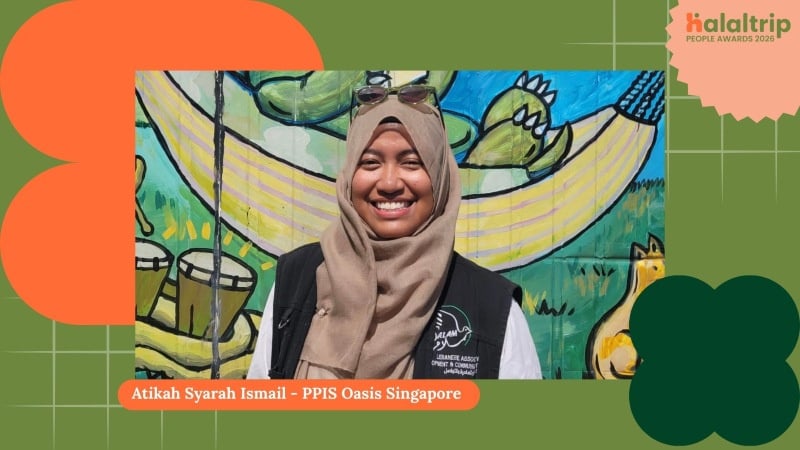
When Atikah Syarah Ismail reflects on her decade in social service, she does not speak in terms of grand gestures or sweeping campaigns. Instead, she grounds her perspective in a simpler reality.
“Service or social services is in just the little things. It didn't have to be like grand gestures. We don't need to be crazy or rich or extraordinary to start something. Just little, little things that we could do with what we have at that time.”
Atikah works as a social worker with PPIS Oasis in Singapore, supporting foster children and families navigating the delicate process of safe and sustainable reunification. In 2023, she took a sabbatical to volunteer on the ground in Palestine. Today, alongside her day-to-day casework, she continues to run grassroots fundraising efforts to deliver monthly essential assistance to families in need.
As an honoree of the inaugural HalalTrip People Awards, an initiative honoring individuals making a lasting difference outside the spotlight, Atikah offers a candid look at what real community support requires, whether in neighborhood estates or halfway across the world.
10+
Years in Social Service
2023
Sabbatical to Volunteer in Palestine
For those outside the non-profit sector who wish to contribute but do not know where to turn, Atikah’s advice strips away the intimidation factor.
“Begin with what they already have,” she explains. “Their skills, their time, or their profession, or their interest. Anything can become service. So, you don’t have to go overseas or start a fundraiser.”
In Singapore, where social infrastructure can feel highly formalized, she points back to the immediate neighborhood:
“We have all these Family Service Centres, and they are really on the ground. They are within the estate, within the community. If you don't know of any resources, I would say helping a family or mentoring a child or helping a neighbor or reaching out to a neighbor, or volunteering regularly at your nearest community center or Family Service Centre. We don't need to start like, ‘Go big or go home.’ You can start small and start near.”
Her years on the ground have also given her a clear view of the structural disconnect between corporate initiatives and grassroots realities. While corporate engagement is often driven by immediate results and defined metrics, community progress moves at a different pace.
“Corporate world is all about KPI and profit, and the community doesn't work like that. Even people don't work like that. We don't grow immediately. It's gradual.”
For corporate entities and leaders looking to make a genuine impact, she emphasizes the need to move past short-term, transactional contributions in favor of sustained investment in education, mental health, healthcare, or local leadership development. Real engagement, she points out, requires a personal commitment to long-term responsibility rather than rapid returns.
Transitioning from casework in Singapore to volunteer work in displaced communities in Palestine and Lebanon forced Atikah to confront her own assumptions.
“From the work that I've already done, it was mostly the importance of listening, or not assuming about somebody else's life,” she says.
Working overseas meant navigating distinct cultural spaces and steep language barriers. During her first weeks in the Middle East, frustrated by the inability to connect directly without relying solely on interpreters, she spent three to five hours every night studying Arabic so she could speak with locals in the markets and host homes.
That effort came from a firm understanding of her role as an outsider:
“My intention was never to come in thinking like, ‘I'm going to save everybody.’ I didn't come here to think that, ‘I'm going to rescue people.’ It was to learn. I wanted to contribute where my strengths and my skills would be of use, and I just wanted to stand alongside people who were marginalized.”
Whether working in familiar territory in Singapore or unfamiliar settings abroad, Atikah views the fundamental responsibility as the same: remaining aware of one's privilege, observing carefully, and listening far more than speaking.
As a Singaporean Muslim who loves to travel, Atikah views the growing intersection between global travel and community awareness through a pragmatic lens. While leisure and sightseeing are natural parts of travel, she believes Muslim travelers hold a higher responsibility regarding how they engage with the places they visit.
“Traveling can actually connect more people. But if you detach yourselves from the realities of the world, or the communities who are facing hardship in the countries that you visit, I think it only reinforces the distance between one another. So as Muslim travelers, I would say choose empathy.”
That empathy, she elaborates, does not require grand acts. It shows up in small, deliberate choices — where travelers spend their money, who they take time to speak with, and whether they treat local populations with respect rather than as visual backdrops.
For operators and decision-makers in the travel industry seeking to curate authentic community experiences, Atikah cautions against romanticizing hardship or treating local populations as tools for a traveler’s personal enrichment. Her message to the industry comes down to three commitments:
Learn Before You Design
Take time to learn local history, sensitivities, and social dynamics before designing itineraries.
Build Long-Term, Verified Partnerships
Work with verified local partners on the ground rather than treating community visits as short-term trends.
Ask, Don’t Assume
Ask local communities what they actually need instead of imposing pre-packaged solutions.
Ultimately, Atikah’s work highlights the precise spirit the HalalTrip People Awards set out to honor: the consistent efforts of individuals who sustain their communities without seeking recognition.
“There's so many people on the ground working. And if we had access to these people or these communities, it would be great, but if not, then you could also just join the band of people that are doing it consistently, and with sincerity.”
It is a reminder that whether serving immediate neighbors or moving through the wider world as travelers, the ultimate measure of presence lies in a simple question: How have you made the world better with the skills and strengths you have?
Know someone making a lasting difference in their community without asking for recognition? Nominate them for the HalalTrip People Awards 2027 here.

