
When travelers reflect on the golden age of Al Andalus, their minds naturally wander toward the sunlit plazas of Granada, Cordoba, and Seville. Yet, further west, where the Tagus River flows gracefully into the Atlantic Ocean, lies a European capital whose very foundations were shaped by over four centuries of Islamic civilization. Long before modern travelers fell in love with Lisbon's pastel hills and iconic yellow trams, this vibrant coastal city was known as Lishbuna, a flourishing center of trade, poetry, and scholarship in Al-Gharb Al-Andalus, the western frontier of Islamic Iberia.
From the early eighth century until the middle of the twelfth century, Lishbuna stood as a beacon of Atlantic commerce and cultural exchange. Today, while centuries have passed, the city's Moorish soul remains intact, woven into the street layouts, architectural details, and everyday traditions of modern Portugal.
To feel the living heartbeat of Islamic Lisbon, one need only step into the maze-like district of Alfama. The neighborhood's very name derives from the Arabic word Al-Hamma, meaning hot springs, referring to the natural thermal waters that once bathed the hillside.
Unlike the broad grid layouts of modern city planning, Alfama retains its authentic medieval Islamic urban structure. Walking through its steep cobblestone alleys reveals narrow stairways, dead end residential hamlets designed for privacy, and whitewashed houses built close together to block the summer heat. Sunlit interior courtyards, stone archways, and overhanging balconies mirror the traditional residential layouts found across North Africa and the Levant, creating an atmosphere that feels timeless.
High above Alfama, sitting atop the city's highest hill, stands the famous Castelo de São Jorge. While recognized today as a national monument, the fortress was originally built during the Islamic period as the fortified citadel (Al-Cáçova) and governor's residence.
Walking along the castle ramparts offers panoramic views across Lisbon's red-tiled roofs to the sparkling Tagus River below. Within the castle grounds, archaeological excavations have uncovered the foundations of eleventh-century Islamic residential quarters, complete with internal courtyards, decorative plasterwork, and sophisticated water management systems. Stretching down from the castle through the slopes of Alfama are intact stone sections of the Cerca Moura, the ancient Moorish defensive walls that once protected the city's inhabitants.
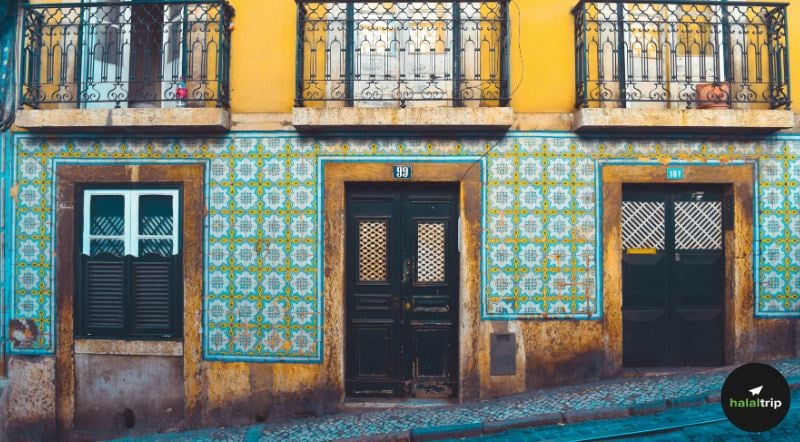
The Moorish legacy in Lisbon extends far beyond physical stone walls; it lives within the very fabric of Portuguese identity. The iconic glazed ceramic tiles known as azulejos, which coat townhouses and public plazas across Portugal, trace their origin to Islamic ceramic traditions (al-zuleycha, meaning small polished stone).
Visitors will also notice an enduring respect for public water fountains (chafariz), inspired by Islamic garden design and public welfare traditions. Even the Portuguese language carries an incredible linguistic inheritance, featuring over nine hundred words of Arabic origin. Everyday expressions like oxalá (meaning God willing, derived directly from insha'Allah), almofada (cushion), and azeite (olive oil) remind us of a shared historical heritage.
Lisbon teaches us that history is never truly erased; it quietly endures in the curve of an alleyway, the pattern of a ceramic tile, and the gentle rhythm of everyday speech. As you look out over the Tagus River from the heights of Alfama, you realize that Lishbuna is not merely a memory of the past, but a living bridge connecting cultures across time.

