
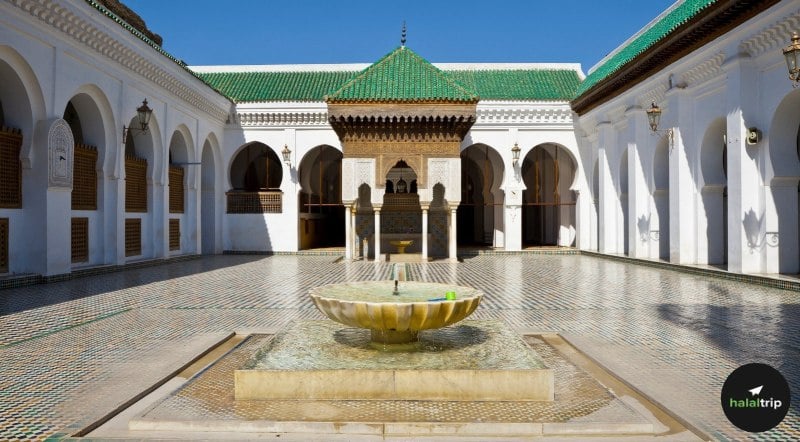
Image Credit: iStock Photo
Do you know that the oldest university worldwide was founded by a Muslim woman? Yes, you heard that right. That is the University of al-Qarawiyyin, founded in 859 CE by Fatima al-Fihri. Recognized by UNESCO and Guinness World Records as the oldest continually operating institution of higher learning on earth, it welcomed students centuries before the universities of Bologna, Oxford, or Paris opened their lecture halls.
Fatima bint Muhammad al-Fihriyya was born in the early ninth century in Kairouan, a flourishing center of Islamic learning in modern-day Tunisia. During her youth, her family joined a major migration westward to the newly established Moroccan capital of Fez, founded under the Idrisid ruler Idris II.
Her father, Muhammad al-Fihri, was a principled and hardworking merchant whose commercial enterprises thrived in their new home. Known within her community as Umm al-Banin, meaning mother of the children, Fatima grew up immersed in classical Islamic scholarship, religious devotion, and business acumen.
When tragedy struck, and both her father and husband passed away within a brief period, Fatima and her sister Mariam inherited an immense fortune. Rather than spending their wealth on personal comfort or passing estate luxuries, the two sisters made an extraordinary choice.
Guided by the Islamic principle of sadaqah jariyah, an enduring charity that continues to benefit humanity long after a benefactor leaves this world, they decided to dedicate their entire inheritance to public endowments. While Mariam funded the Andalusian Mosque on the eastern bank of the river, Fatima set her sights on building an expansive center of worship and scholarship for the growing Qarawiyyin community.
For Fatima, constructing a house of God and learning was not simply a financial transaction; it was a spiritual act of worship that required uncompromising faith.
To ensure the project remained free from any moral compromise or disputed land claims, she purchased a large plot of land from a local merchant using her own clean inheritance. Determined that no materials of questionable origin enter the construction, she ordered that all foundational materials, including stone, sand, and water, be quarried directly from the property itself.
Even more astonishing was her personal spiritual discipline. Fatima made a solemn vow to fast every single day from the first morning foundation trenches were dug until the final arch was completed. For more than two full years, through blazing summer heat and chilly mountain winters, she maintained her daily fast, offering prayers of gratitude at every stage of construction.
When the complex finally opened its doors in the blessed month of Ramadan in 859 CE, Fatima stepped into the prayer hall, fell into prostration, and thanked God for allowing her to bring this place of faith and intellect into reality.
What began as a community mosque quickly evolved into a powerhouse of scholarship. Al-Qarawiyyin became the birthplace of the modern university model, introducing structured curricula, specialized chairs of study, rigorous academic examinations, and the ijazah, the historic precursor to the modern university degree.
The university did not view secular knowledge and sacred study as separate pursuits. Students gathered in circular study rings beneath cedar wood ceilings to study the Quran, Hadith, and Islamic jurisprudence alongside astronomy, higher mathematics, medicine, chemistry, geography, and classical grammar.
Scholars from across the Mediterranean and beyond walked its courtyards. Luminary thinkers studied or taught within its walls, including the historian Ibn Khaldun, the philosopher Ibn Rushd, the master cartographer al-Idrisi, the Jewish philosopher and physician Maimonides, and the Christian scholar Gerbert of Aurillac, who later became Pope Sylvester II and helped introduce Arabic numerals to Europe.
Fatima’s endowment fostered an environment where reason, faith, and intellectual inquiry crossed geographical and religious boundaries, preserving and expanding human knowledge during what the Western world once called the Dark Ages.
Visiting Fez today offers travelers a living encounter with Fatima al-Fihri’s vision. The University of al-Qarawiyyin remains an active mosque and spiritual center at the core of the medina.
While the inner prayer halls are reserved for worshippers, visitors can gaze through the magnificent cedar wood portals to admire the central courtyard, where sunlight dances across intricately tiled zellij floors, carved stucco archways, and graceful marble fountains inspired by Andalusian design.
Nearby, the historic al-Qarawiyyin Library, restored in recent years, holds thousands of irreplaceable manuscripts, including ninth-century Quranic texts inscribed on gazelle parchment, early astronomical charts, and original medical treatises.
Exploring the surrounding lanes is a joy for Muslim travelers. Fez is a paradise for Halal dining, where traditional family-run riads and garden terraces serve aromatic lamb tagines cooked with prunes and almonds, sweet and savory pigeon pastilla dusted with cinnamon, and piping hot glasses of fresh mint tea.
When the call to prayer echoes over the rooftops from the minaret Fatima helped build, joining the congregational rows connects you directly to more than eleven centuries of unbroken devotion.
Fatima al-Fihri demonstrated that true vision looks beyond immediate horizons. Her legacy stands as an eternal reminder of the pioneering role Muslim women have always played in education, community leadership, and intellectual development.
In every diploma issued today, in every lecture hall that opens its doors across the world, a faint whisper of her sincerity still resonates. She showed that when faith is paired with intellectual ambition and selfless generosity, the impact can outlive empires and enlighten the world for millennia.

