
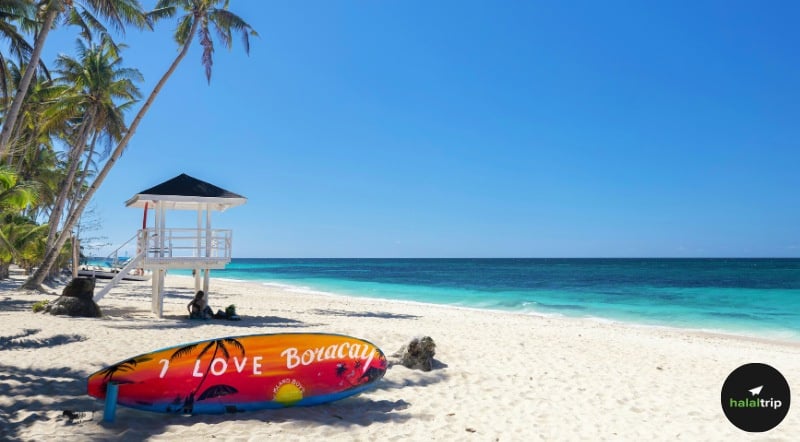
Boracay’s White Beach is often cited as one of the world’s premier island destinations, defined by its powdery sand and crystalline waters. The special aspect from the island, more than just its aesthetic beauty, is how it represents a modern expression of an ancient maritime civilization.
The same mastery of the sea that defined the Sulu Sultanate centuries ago has shaped a culture of hospitality and abundance that makes Boracay feel naturally compatible with the values of the global Muslim community.
The commitment to inclusive travel is most visible at Marhaba Cove, the only dedicated Muslim-friendly beach area in the Philippines. Designed specifically to offer privacy and comfort, this cove allows travelers to enjoy the island’s natural beauty in an environment that respects faith based sensitivities.
It is a pioneering space that moves the conversation from simple accommodation to proactive celebration, ensuring that every guest can experience the paradise of Boracay without compromise.
The connection between the historic south and these northern shores is not merely political; it is fundamentally culinary. The same Sulu Sea that served as a highway for 13th-century traders continues to feed Boracay’s tables today. This creates a powerful gastronomic continuity where the ocean remains the primary provider.
From the local markets to high end beachfront dining, the abundance of fresh fish, crab, and lobster ensures that the Halal-conscious traveler finds an effortless variety of permissible options. To dine by the shore in Boracay is to participate in a maritime tradition that has sustained the archipelago for nearly a millennium.
One of the most poetic experiences on Boracay can be found at the intersection of geography and worship. Because White Beach faces west, the direction of the Qibla aligns perfectly with the horizon.
As the sun begins its spectacular descent, the timing for Maghrib prayer arrives alongside the island’s most beautiful hour. To pray on the sand as the sky turns to gold is an experience signifying that Muslim travelers are not newcomers here, but guests in a landscape that has always been oriented toward them.

