
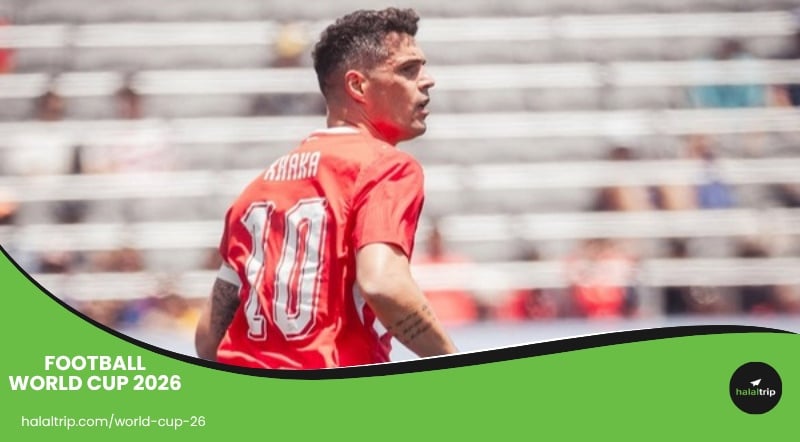
Image Credit to Granit Xhaka on Instagram
The roar of the crowd during a global tournament often centers on the goalscorers, yet the true heart of any historic team resides in the midfield. For the Switzerland national football team, that position has long been anchored by a commanding presence. Granit Xhaka has stood at the center of the Swiss squad through four consecutive World Cup cycles, mapping a historic international path from Brazil in 2014 to the grand pitches of North America in 2026.
While many fans marvel at his incredible longevity on the field, the deeper story of the Muslim Swiss captain is a beautiful lesson in resilience, self discipline, and the personal identity that shapes his leadership style.
To understand the hunger and unwavering professional focus that Xhaka brings to every match, one must look far beyond the boundary lines of the pitch. Born in Basel, he was raised in a proud ethnic Albanian family originating from Besiane, Kosovo. His parents navigated the intense political turmoil of the former Yugoslavia, with his father enduring years of political imprisonment before the family emigrated to Switzerland in 1990 to build a safe future from scratch.
Growing up in this tight knit household, Xhaka was raised with an inherent understanding of sacrifice, gratitude, and traditional values. While his Islamic faith remains a personal matter that he carries away from the media spotlight, the values of family honor, clean living, and mutual respect are evident in his daily habits. The fiery youth who started competitive sport at the age of four eventually evolved into the composed and respected team leader wearing the captain armband. This remarkable transition is the result of a grounding identity that reminds him of who he is representing every time he steps onto the grass.
For Xhaka, his cultural and spiritual identity is fully integrated into how he communicates with the world. He remains connected to his roots, speaking fluent Albanian alongside German and English, often using his linguistic skills to connect with fans and fellow players from diverse backgrounds. His mother famously captured the hearts of onlookers during international tournaments by wearing a custom shirt split perfectly down the middle, showcasing the flags of Switzerland and Albania to represent their double heritage.
This fluid sense of belonging allows him to move gracefully across different cultural landscapes, proving that a person can be completely devoted to their professional national duties while remaining anchored in their ancestral heritage. For young athletes tracking his journey, seeing a prominent player with Muslim roots and an Albanian heritage succeed at the highest level of European sports provides an invaluable sense of representation and pride.
True leaders are rarely defined by staying comfortable, a reality Xhaka proved decisively in his recent club career movements. After leading Bayer Leverkusen in the Bundesliga through a historic, undefeated domestic double and anchoring them at the pinnacle of European football, he made a professional choice that left many analysts completely stunned. He chose to move to Sunderland A.F.C., trading the safety of guaranteed elite tournaments for the gritty challenge of a newly promoted Premier League side.
Where critics saw a massive professional risk, the Swiss veteran saw a beautiful opportunity to build something lasting. Stepping immediately into the captaincy on Wearside, his presence instantly transformed the culture of the dressing room, infusing the younger players with a new standard of professionalism. This willingness to embrace the difficult path is a testament to his inner grounding, proving that his athletic motivation is fueled by a deep desire to test his character against the toughest challenges.
This blend of emotional maturity and tactical intelligence was the driving force behind the historic Swiss campaign in the summer of 2026, where he guided a highly talented group of athletes into the quarterfinal stages of the tournament. The captain has consistently spoken about the responsibility of senior players, emphasizing that true leadership requires setting an example in daily habits rather than just delivering motivational speeches.
By anchoring the midfield with composure during high stakes penalty shootouts and tense defensive stands, he has given a rising generation of athletes the confidence to believe they can compete against any superpower on Earth. For our global community of readers, his journey offers a beautiful reminder that our personal heritage and inner values are not anchors holding us back; they are the ultimate source of strength that allows us to lead others with genuine dignity.
Granit Xhaka’s legacy is secured in the history books of global sports, defined not just by the rare distinction of playing in four separate world tournaments, but by the clean character he preserved along the way. By remaining true to his roots and leading with humility, he has shown the world that the measurement of an athlete is the lasting impact they leave on the hearts of their peers.


Youcinez
Great read! Granit Xhaka's journey is a reminder that discipline, leadership, and staying true to your values can go hand in hand with success in professional football. I also appreciate how the article highlights the importance of representation and faith in sports. Stories like this inspire not only football fans but anyone striving to stay committed to their principles. Thanks for sharing such an insightful perspective.