
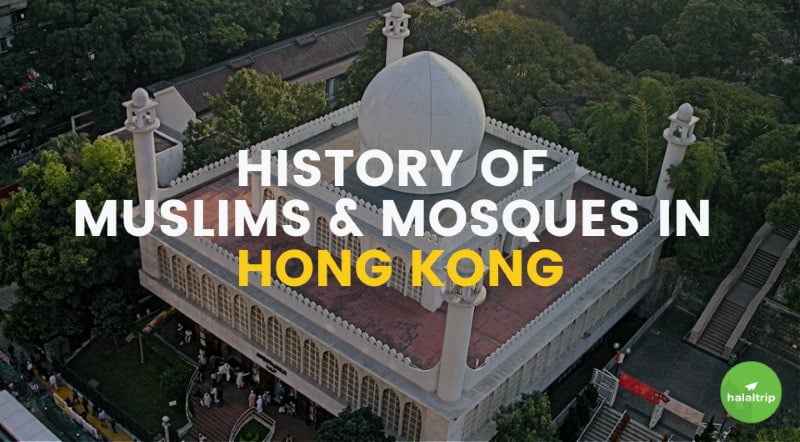
The Kowloon Mosque and Islamic Centre, the largest mosque in Hong Kong
When it comes to Muslim history, Hong Kong might be the last place that comes to mind. The city is known for its dim sum dishes and martial arts legends like Jackie Chan and Bruce Lee. However, there's more to Hong Kong than what the usual travel websites show you.
Hong Kong today is home to more than 300,000 Muslims (and rising) accounting for around 4% of the city’s population. The Muslim community here is incredibly diverse, inclusive of those from the Indian subcontinent, Western China, the Malay and Indonesian Peninsulas, and many other parts of the world.
I've been living in this city for more than two decades and I’ve always been curious about how Islam reached Hong Kong.
Join our telegram channel for the latest trends on travel and food.

European colonization was one of the major contributors to how Islam came to the bays of Hong Kong. Just after Britain colonized the city, it was in need of security, so they brought in soldiers and sailors to protect the borders as well as the goods which came through the British East India Company.
Many of these soldiers came from Attock, Lahore, Abbottabad, and Punjab, from the then undivided India and present-day Pakistan, where most were Muslim. They were called “Lascars”, which means soldier or sailor in Persian and Bengali. They would later contribute to the building of mosques, weaving Islam intoHong Kong's history. These soldiers also went on to permanently settle here, making the city their new home.
Islam in China was introduced as early as the Tang and Song dynasties during the years 618–1279 CE through the Silk Road, where traders from Persia and Arabia built mosques as well as established businesses. There are reports of missions coming to China sent by Muslim rulers with caravans arriving in Chang’an (which is the old name of Xi’an) and Kaifeng, which is in the Henan province. They were called “tributary” missions and were given “free lodging, luxurious entertainment, and benevolent gifts” by the Chinese government which exceeded the value of the goods they had brought. Since then, Arabs and Persians remained active economically in the Tang empire’s trading ports.

Image Credit: Underwaterbuffalo, CC BY-SA 4.0, via Wikimedia Commons
The first group of Muslims to set foot in Hong Kong were believed to have been the soldiers and sailors also known as the Lascars in 1841. They settled near present-day Sheung Wan. Due to this, the road was named Upper and Lower Lascar Row, referring to a row of houses where the soldiers lived.
Almost a decade later, in 1849, due to the increasing number of Muslims, some members of the early Muslim community applied for a piece of land for a mosque to be built and leased it in the name of four Muslims; Shaik Moosdeen, Mahomed Arab, Shaik Carther, and Hassan Malay. The mosque was initially named Mohammedan Mosque, until it was later rebuilt in 1915 by a Muslim businessman Essack Elias from Bombay who financed the entire re-building of the mosque, it then became known as the Jamia Mosque. It was also known as Shelley Mosque (due to its proximity to Shelley Street). It also had other names such as the Lascar Temple in previous historical records.
The Incorporated Trustees of the Islamic Community Fund of Hong Kong, commonly known as the Board of Trustees, now manage the Mosque and related community affairs.
The Mosque was granted Grade 1 historical status in 2010 from the Antiquities and Monuments Office, officially declaring the Mosque “worthy of preservation as much as possible”. It was declared a monument along with City Hall and Lui Seng Chun, a shophouse in Mong Kok. The Mosque is also part of the heritage trail which starts from Sheung Wan covering the main areas of attraction in that district.
I strongly recommend visiting this mosque to appreciate the history of Muslims coming to Hong Kong and making Islam a part of the city's history. Apart from the architecture and antiquity of the Mosque, I think we can appreciate the fact that Allah has granted us Islam, even in the most remote places.
How to get there:
Get off at Central Station Exit D2 and walk to the mid-level escalator and go all the way up until you see the dome of the mosque. Google Maps or Moovit will come in really handy.
Address: 30 Shelley St, Mid-Levels, Hong Kong

Image Credit: Shafakt at English Wikipedia, CC BY-SA 3.0, via Wikimedia Commons
The Kowloon Mosque and Islamic Centre, located in Tsim Sha Tsui, one of Hong Kong’s busiest shopping districts.
Kowloon Mosque is probably the most iconic and popular Mosque in Hong Kong. It is situated in the Tsim Sha Tsui area which is a major shopping and tourist hub. There are numerous malls and museums around the area, as well as a beautiful view of Victoria Harbour. The Mosque itself is such a huge structure that’s hard to miss even in an area full of hustle and bustle.
According to Haji Kafayatullah Rahmani, the former chairman of the Kowloon Mosque Reconstruction Committee, in his 2012 booklet “Kowloon Mosque and Islamic Centre, Kowloon, Hong Kong, 2012”, he writes that “Mohammadans of Upper India (Khattaks & Yusfuzais tribes and men from Jhelum, Shahpur, Rawalpindi, Hazara, and Gujrat) arrived in Kowloon to serve in the Hong Kong Regiment of the British Army”.
The Mosque was built in 1896 under the supervision of Col. E.G. Barrow who oversaw the construction of it for the Muslim soldiers stationed at the Whitfield Barracks (which used to be in the area of present-day Kowloon Park). The demand for the Mosque came after Muslim soldiers were praying in a makeshift structure within the barracks and wanted to build a dedicated prayer space nearby. The Mosque was built with the donations of the Muslim soldiers themselves in 1896.
The soldiers also helped build quarters for the Imam and a guesthouse for Muslim travelers. The Mosque’s first imam was Maulvi Gulab Shah.
The Mosque was initially managed by the Muslim soldiers stationed there who were from, what was then, undivided India. Upon the creation of Pakistan on the 14th of August 1947, it was managed by the Pakistan Association, which later was run by the Trustees after the formation of the organization.
Eventually, the Mosque was in need of renovation due to its run-down condition. The renovation was initiated following the building of the Tsim Sha Tsui station by the Mass Transit Railway (MTR) in December 1979. Due to the construction, the Mosque’s structure was affected and therefore needed a full revamp. The Mosque was finally renovated and rebuilt on 6 March 1981, opening its doors to the public again on 11 May 1984.
Being the largest Mosque in the city, it has segregated gateways for men and women, three prayer halls, two madrasahs, a community hall on the ground floor, and a library. The Mosque can also accommodate up to 3,500 worshippers. And the best part is that it has a lot of Halal restaurants in the nearby streets as well as the Chungking Mansions, which is a complex full of Halal food options.
This Mosque is a must-visit for anyone visiting the city. Perform your Salath hereand experience the Muslim atmosphere at Hong Kong's biggest Mosque.
How to get there:
Get off at Tsim Sha Tsui Station Exit A1 and you'll see the minaret to your left.
Address: 105 Nathan Rd, Tsim Sha Tsui, Hong Kong

Image Credit: Alexandquan, CC BY-SA 4.0, via Wikimedia Commons
These two mosques may not be as well-known as the others, but they still hold an important place in Hong Kong’s Muslim history. Stanley Mosque was built inside of the Stanley Prison compound where there were Muslim staff from India and Pakistan working for the Prison Department. There were around 400 Muslims working for the department during the early twentieth century.
The Mosque was built due to the change of the police headquarters. Initially, the police headquarters was situated in Central and most of the staff would go to Jamia Masjid to pray. However, with the change of headquarters to Stanley, they needed a place to pray; which led to the building of the Mosque, which opened on 1 January 1937.

Image Credit: Underwaterbuffalo, CC BY-SA 4.0, via Wikimedia Commons
The Cape Collinson Mosque, also known as the Chai Wan Mosque was built in exchange for the reclamation of land in the Ho Man Tin area, where the government resumed the old Ho Man Tin Mosque and Cemetery in Kowloon for redevelopment. The government then built a small Mosque in Cape Collinson, (present-day Chai Wan) to cater to the needs of the Muslim community. The Mosque opened on 4 August 1963.
However, due to the decrease of Muslim prison staff in Stanley Mosque and the lack of access in Chai Wan Mosque, there is lesser use of these mosques nowadays. But, it is still being used and maintained by Muslims living and working in that area. So do give these mosques a visit.
How to get there:
Stanley Mosque – Take Bus No, 260 to Stanley Village from Admiralty Station and get off at Stanley Prison bus stop.
Address: 53 Tung Tau Wan Rd, Tung Tau Wan, Hong Kong
Cape Collinson Mosque / Chai Wan Mosque – Get off at Chai Wan Station Exit A – and follow the route in this video
Address: Chai Muslim Mosque and cemetery, Cape Collinson Road, Tai Tam Gap, Chai Wan

Image Credit: Gunguti Hanchtrag Lauim, CC BY-SA 4.0, via Wikimedia Commons
Masjid Ammar is a living contribution of the Chinese Muslims who have settled in Hong Kong. The Mosque was designed by an architect named Ramju Sadick, a Chinese Muslim. The original building was finished in 1967.
At the time, the first Muslim cemetery was located at 7 Seymore Street (where the current Jewish synagogue is located) and was relocated to Happy Valley, near the current building. A small Mosque was built adjacent to the cemetery and an increasing number of Muslims went to pray there. After World War 2, a new Mosque was constructed on the same site where it remained until 1978.
In order for the Aberdeen Tunnel to be built, the government had to repossess the land in which the Mosque stood. In return, they were compensated with the land on Oi Kwan Road, Wan Chai as well as a compensation of HK$2.5 million for the construction of the new Mosque in one of the major city centers on Hong Kong Island.
The construction of the Mosque started in the 1970s and was open to the public on 14 September 1981. The Mosque has eight floors, with a restaurant, prayer rooms, a library, medical services, and a seminar room. Apart from this, the Islamic Union of Hong Kong and the Hong Kong Islamic Youth Association are also based in this center.
This Mosque is located in the Wan Chai district, the city center of Hong Kong Island. There are a few Halal restaurants nearby, but I would recommend trying a few dishes in the Islamic Centre Canteen, which is on the fifth floor of the Mosque.
How to get there:
Get off at Wan Chai Station Exit A2 and follow the route through Google Maps.
The story of Muslims in Hong Kong is deeply interwoven with the city’s own growth as a global crossroads. From South Asian soldiers and traders who first brought Islam here during the colonial era, to the Chinese Muslim community that continues to nurture it today, the mosques of Hong Kong are more than places of prayer. They are living witnesses to resilience, diversity, and faith across centuries of change.
Each mosque—from the historic Jamia Mosque in Central to the modern Masjid Ammar in Wan Chai—tells a chapter of this journey. Together, they remind us that Hong Kong is not only a city of commerce and culture, but also a city where Islam has quietly flourished and adapted.
For Muslim travelers today, the mosques offer both worship spaces and a connection to this legacy. Visiting them is not only a spiritual pause, but also a way to discover Hong Kong’s rich, multicultural past.

