
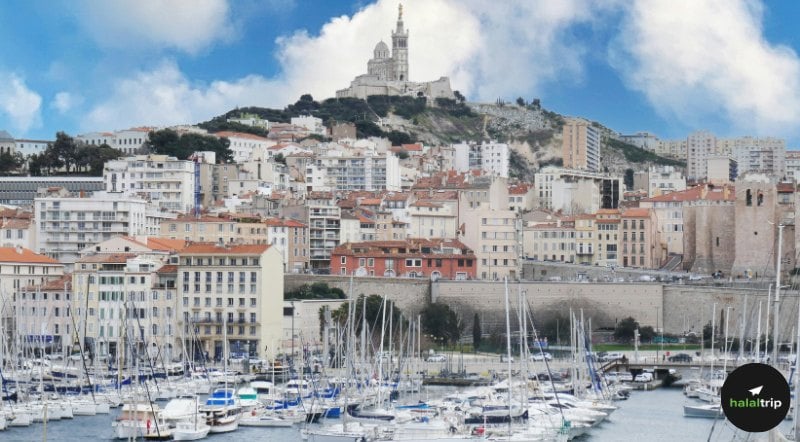
Standing along the stone quays of Marseille’s Old Port (Vieux-Port) as fishing boats bob gently in the morning tide, you can feel a sense that this is not your typical French metropolis. While Paris looks inward toward the heart of mainland Europe, Marseille has spent over twenty six centuries gazing south toward the warm waters of the Mediterranean. It is a legendary port of arrival, a place where sailors, traders, scholars, and families from North Africa, the Middle East, and southern Europe have exchanged goods, ideas, and traditions across the waves.
For the curious Muslim traveler, Marseille represents one of the most culturally vibrant and welcoming cities in Western Europe. Here, Islamic heritage is not confined to distant museum archives; it lives openly in the aromatic spice markets, the melodic greetings exchanged along tree lined avenues, and the shared culinary traditions that define the city’s daily rhythm.
Marseille’s identity as a bridge to the Islamic world reaches back many centuries. Because of its strategic geography on the southern coast of France, the city served as a primary European trading hub for Mediterranean merchants during the medieval era. Historic records chronicle vibrant commerce between Marseille and major North African ports, including Algiers, Tunis, and Alexandria.
During the sixteenth century, the port welcomed Ottoman naval fleets and diplomatic envoys following the historic alliance between King Francis I and Sultan Suleiman the Magnificent. In the nineteenth and twentieth centuries, these maritime links deepened as generations of Algerian, Moroccan, and Tunisian workers arrived through its harbor, bringing with them architectural crafts, literary traditions, and Islamic values that helped rebuild and enrich post-war France.
To experience the living soul of North African culture in Marseille, one only needs to walk a few minutes inland from the harbor into the historic Noailles neighborhood. Known warmly by locals as Le ventre de Marseille, or the belly of Marseille, this vibrant quarter is anchored by the bustling Marché des Capucins.
Walking through the market will be a feast for the senses. Air filled with the earthy scent of ground cumin, paprika, and dried coriander leads you past colorful stalls piled high with sweet dates from the Sahara, glistening Mediterranean olives, and freshly harvested mint. Neighborhood bakeries showcase trays of warm makroudh, honey-soaked baklava, and crusty Maghrebi semolina bread straight from the oven. Sitting outside a local cafe with a steaming glass of pine nut mint tea while listening to the hum of Arabic and French conversation will show every traveler a community that has found a true sense of belonging.
Marseille's celebration of Mediterranean unity is expressed visually at the entrance of the Old Port. There stands the Museum of European and Mediterranean Civilizations, widely known as the Mucem. Designed with an intricate latticework facade that mimics the delicate geometry of Islamic mashrabiya screens, the museum is linked by a footbridge to the seventeenth-century Fort Saint Jean.
Inside, the museum houses extensive collections documenting the shared histories, scientific discoveries, and artistic movements of Mediterranean societies. Walking through its quiet galleries provides a thoughtful perspective on how Islamic calligraphy, astronomy, and agriculture influenced European thought, illustrating that the sea was never a barrier, but rather a great highway connecting diverse peoples.
Thanks to its large and well-established Muslim population, traveling through Marseille as a Muslim visitor is both seamless and rewarding. The city provides exceptional faith infrastructure alongside one of the finest culinary scenes in France.
Finding authentic Halal dining is effortless throughout Marseille. In neighborhoods like Noailles, Belsunce, and around Saint Charles, you will find Halal eateries serving couscous loaded with tender lamb, savory Tunisian tajine maakouda, and freshly grilled skewers. For seafood lovers, Marseille’s traditional Provençal kitchens offer wonderful opportunities to enjoy authentic fish soups, baked sea bream, and grilled calamari prepared with local olive oil and herbs.
For daily prayers, Marseille is home to dozens of active community mosques and prayer centers spread across its districts. Notable locations include the Mosquée de Malaval in the second arrondissement, offering a beautiful prayer hall adorned with traditional tilework and calligraphy, as well as the Bilal Mosque, ensuring that travelers always have a peaceful place for prayers and reflection.
Marseille stands as an inspiring reminder that cities are at their best when they welcome the world with open arms. From the historic docks of the Old Port to the bustling alleys of Noailles, the city's Islamic and North African connections are woven deeply into its spirit, proving that when diverse cultures meet along the sea, they create an enduring legacy of shared humanity.

