
Image Credit: Aleksandra Khoroshykh on Unsplash
High above the tiled rooftops of the old town, the melodic voice of the muezzin calls worshippers to Maghrib prayer. It is a sound that has echoed across Melaka for more than six centuries, linking the present moment to a maritime civilization that fundamentally altered the spiritual landscape of an entire continent.
Today, many travelers may recognize Melaka for its colonial red church, the weathered ruins of A Famosa, and the weekend buzz of night market stalls.
However, beneath these familiar postcard images lies an infinitely richer story. Long before European galleons arrived on these shores, the Malacca Sultanate was the glittering capital of the Malay world, a cosmopolitan coastline where faith, commerce, and culture met to create the historic gateway of Islam in Southeast Asia.
To understand how Islam flourished here, you have to look at the wind and the water. The narrow Strait of Malacca forms a natural funnel connecting the vast expanses of the Indian Ocean with the South China Sea. For ancient navigators, their ocean voyages were governed entirely by the rhythm of the monsoons.
Between December and March, the northeast monsoon brought Chinese junks, Ryukyu vessels, and Javanese prahus sailing into harbor. When the winds shifted between May and September, the southwest monsoon carried Arab dhows, Persian vessels, and Gujarati trading ships across the Bay of Bengal.
Because captains had to wait months for seasonal winds to turn, Malacca evolved into far more than a simple refueling stop. It became a vibrant city where merchants of every nationality settled, built homes, and exchanged ideas.
The Portuguese apothecary and chronicler Tome Pires wrote with astonishment in the early sixteenth century that up to eighty four different languages and dialects could be heard in the city’s bustling markets, noting that whoever was lord of Malacca had his hand on the throat of Venice.
Crucially, the arrival of Islam here was not carried on the edge of a sword. It arrived quietly in the holds of trading ships, carried by Muslim merchants, sea captains, and Sufi teachers who lived their beliefs in everyday life.
In an era when foreign ports could be lawless and volatile, Muslim traders in Malacca stood out for their remarkable integrity. They adhered strictly to honest weights and measures, honored spoken agreements, and treated business partners with dignity. Local populations and regional traders observed this moral rectitude, realizing that Islam was not merely an abstract philosophy, but a practical way of living rooted in justice, compassion, and community.
The transformation of Malacca from a sleepy coastal village into an empire began around the year 1400 with the arrival of Parameswara, a fugitive prince from the declining Buddhist kingdom of Srivijaya.
Recognizing the tactical brilliance of the river mouth, he established a settlement that grew with breathtaking speed. The defining turning point came in the early decades of the fifteenth-century. Through close trade relationships and royal marriage alliances with the established Muslim sultanate of Pasai in northern Sumatra, the ruler embraced Islam, taking the name Sultan Iskandar Shah.
This royal conversion catalyzed a civilizational shift. Successive rulers, particularly Sultan Mansur Shah and Sultan Alauddin Riayat Shah, established the court as the preeminent patron of Islamic arts, legal science, and theological learning in the Malay world. To foster fair commerce, the sultanate codified two pioneering legal texts: the Hukum Kanun Melaka (the civil legal digest) and the Undang Undang Laut Melaka (the maritime laws of Malacca).
These written codes blended Islamic jurisprudence with Malay customary traditions (adat). They outlawed theft and piracy, protected visiting merchants from extortion, established clear maritime dispute procedures, and instituted the office of the Shahbandar, harbor masters appointed to look after foreign trading communities according to just legal standards.
Malacca became an oasis of predictable, ethical commerce, prompting thousands of international merchants to make it their permanent home.
With royal patronage and flourishing commerce, Malacca grew into the intellectual capital of Southeast Asian Islam. The court funded translations of Arabic religious treatises into classical Malay, employing the newly developed Jawi script, an Arabic script adapted with extra characters to write the Malay language.
Malay rapidly evolved into the lingua franca of regional commerce, scholarship, and religious discourse, meaning that anyone wanting to participate in maritime trade naturally learned the language and encountered the teachings of Islam. Sufi masters and scholarly theologians gathered at the sultan’s court, teaching students who had traveled from every corner of the archipelago.
When regional traders from Java, Brunei, the Sulu Archipelago, and the distant Moluccan Spice Islands concluded their seasonal trading business in Malacca, they sailed home carrying both luxurious textiles and a newly embraced faith.
Through these peaceful maritime networks, the teachings of the Quran spread across islands and archipelagos, laying the historical foundations for Islamic polities like the Sultanate of Demak in Java, the Sultanate of Brunei on Borneo, and the Sultanate of Ternate in eastern Indonesia.
For the heritage-conscious Muslim traveler walking through Melaka today, the most vivid testament to this glorious synthesis lies in its architecture.
Unlike modern urban mosques topped with imported Middle Eastern onion domes, the historic places of worship in Melaka look distinct. They feature tiered, pyramidal timber roofs that rise in three harmonious layers, reflecting regional vernacular craftsmanship, climate-responsive design, and spiritual symbolism.
Each tier in these traditional roofs represents a stage of the spiritual journey in classical Islamic thought: Shariah (the foundational law) at the broad base, Tariqah (the spiritual path) in the middle, and Haqiqah (the ultimate divine truth) at the soaring peak.
These architectural masterpieces invite slow contemplation:
Offering prayers in these historic mosques is a deeply humbling experience. Kneeling on floors where generations of sailors, scholars, and local families have bowed their heads for centuries can create a sense of connection to the pioneers of faith who walked here before us.
The legacy of the Malacca Sultanate offers a timeless lesson for our modern world. It reminds us that faith flourishes best not through coercion or dominance, but through the power of character, ethical commerce, and an open heart toward other cultures.
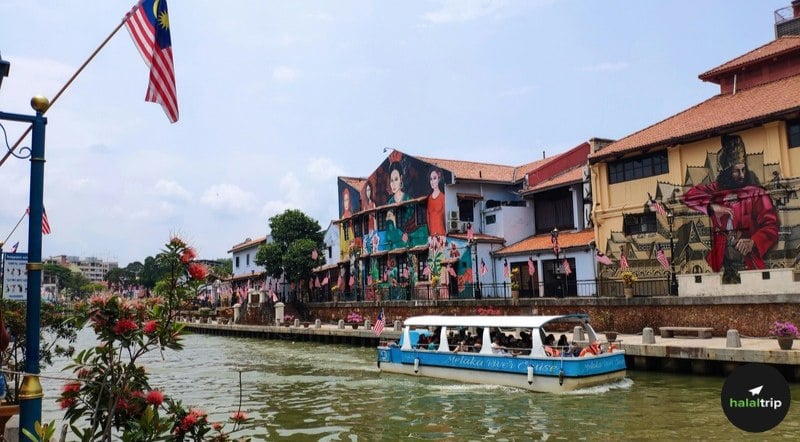
When you walk along the river at sunset, hearing the adhan drift out over the strait, you are standing at the exact place where the ocean carried faith to an entire region. It is a heritage of peaceful connection, creative beauty, and steadfast devotion, waiting to be rediscovered by every traveler who walks its historic lanes.

