
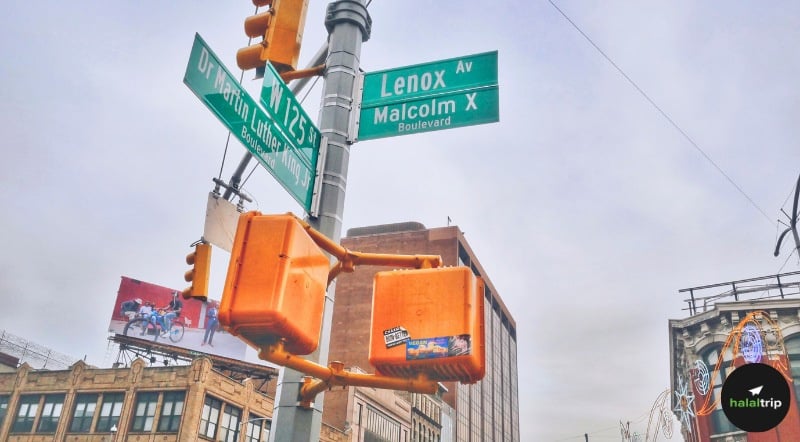
As the world descends upon New York for the 2026 World Cup, the City’s cheers will be felt far beyond the stands of New York New Jersey Stadium. For Muslim travelers, this tournament offers more than a chance to watch the games; it’s also an opportunity to walk the streets of a global capital where our history continues to play a role. In the City, there is no place where this pulse is stronger than Harlem.
From the 1940s through the mid ’60s, the City’s Hotel Theresa was the social heart of Black New York and the operational base for one of the Muslim world's most enduring figures of the 20th century, Malcolm X. Known as the “Waldorf of Harlem,” the hotel was one of the only desegregated luxury destinations welcoming Black visitors. Today, the building’s white terracotta facade still dominates the corner of 125th Street and Adam Clayton Powell Jr. Boulevard as a designated City Landmark that also now functions as an office building.
It was here that Malcolm X once met with Fidel Castro during his 1960 visit to the United Nations, which brought worldwide attention to the hotel and neighborhood. By 1964, Malcolm X had founded the Organization of Afro-American Unity, using the Hotel Theresa as a base for its offices, and further anchoring his revolutionary vision within NYC after his transformative Hajj to Mecca. For any Muslim traveler, standing before this landmark is a reminder of a man whose journey brought him to discover Islam as a bridge for all humanity.
"I’m for truth, no matter who tells it. I’m for justice, no matter who it is for or against. I’m a human being, first and foremost, and as such I’m for whoever and whatever benefits humanity as a whole." ーMalcolm X
The Islamic spiritual weight of Harlem is perhaps most felt at Masjid Malcolm Shabazz on West 116th Street. The site once served as a Nation of Islam mosque where Malcolm X delivered sermons that shook the nation before his 1964 Hajj would inspire him toward Sunni Islam. Although the original structure was firebombed in 1965, the community’s resilience saw it reborn in 1976 as a Sunni mosque, crowned with a striking green dome that continues to stand as a beacon of the faith's permanence in New York.
To enter this space for prayer is to walk in the literal footsteps of a giant whose multifaceted legacy includes his transformative impact on Muslim identity in America. Renamed Masjid Malcolm Shabazz in commemoration, it remains a vital sanctuary where his legacy of dignity and faith continues today.
“I could spend the rest of my life reading, just satisfying my curiosity—because you can hardly mention anything I'm not curious about.” ーMalcolm X
Walking south from 125th Street along Malcolm X Boulevard offers a chance to reflect on the man who arrived in this city as a young seeker and left it as a global icon. Today, this stretch of Harlem is an active cultural route where you can spend an afternoon immersed in his story. You can start at the YMCA where he lived or visit the Malcolm Shabazz Harlem Market, a vibrant community space specializing in goods from across the African continent. Browse carved wood statues, traditional textiles and jewelry from vendors hailing from Senegal, Nigeria, Kenya and Ghana.
Walking north from 125th Street leads to the Schomburg Center for Research in Black Culture, which began its yearlong centennial celebration in 2025 until now. The center holds the premier archives of Malcolm X’s life, preserving the intellectual and spiritual evolution of a man who challenged the world's injustices. Visitors can also explore a vast, vital record of Black life in America and rotating exhibitions that map the intellectual heart of Harlem.
“We need more light about each other. Light creates understanding, understanding creates love, love creates patience, and patience creates unity.” ーMalcolm X
The Mosque of Islamic Brotherhood on 113th Street serves as a living testament to the specific orthodox vision Malcolm brought home from his 1964 Hajj. Today, it remains a welcoming space for those tracing the roots of Black American Muslim life, carrying forward the work Malcolm began decades ago. More than a historic site, it is an active, thriving center of worship that proves his vision of a global Ummah remains a reality in Harlem.
“History is a people's memory, and without a memory, a man is demoted to the lower animals.” ーMalcolm X
The site of the former Audubon Ballroom, now The Malcolm X & Dr. Betty Shabazz Memorial and Educational Center, is where Malcolm X’s life was taken in 1965. It has been transformed into a space that celebrates the couple’s shared legacy of activism and education, and includes a 63-foot mural and a life-size bronze statue of Malcolm X. Make sure to check their social media and schedule in advance, as the center primarily opens its doors for specific galleries and community events.
The neighborhood surrounding these landmarks remains a vital extension of his legacy, where the sound of the Adhan carries across the same streets he once walked. Walking these blocks during the 2026 World Cup is a chance to stand in the presence of a history that shaped the global Ummah and witness the enduring impact of a man who reimagined Islam as a path toward universal community and peace.
To learn more about NYC’s Muslim history and see the full map of these landmarks, download the New York City Halal Travel Guide. It provides exact locations for prayer spaces, historic sites and community hubs across the City.

