
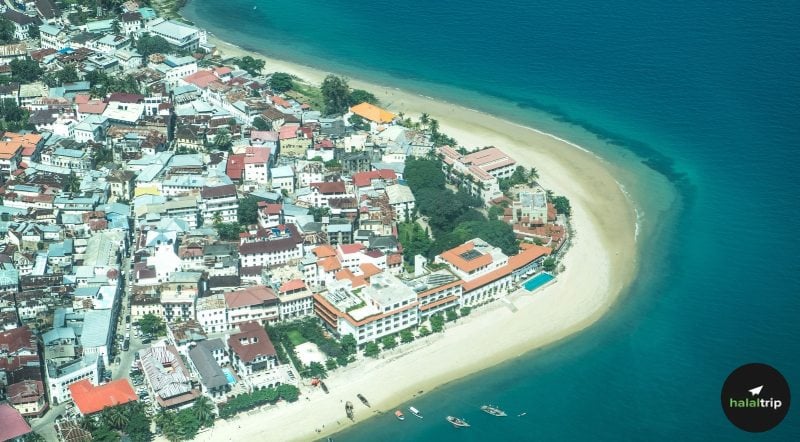
Image Credit: Javi Lorbada on Unsplash
Known locally as Mji Mkongwe, Stone Town is the historic beating heart of Zanzibar. To visitors, the island is often framed as a tropical paradise of palm trees and white coral beaches.
However, beneath all the tropical paradise, the town holds a deep Muslim history. It is an extraordinary living legacy of the shared history of the Islamic world, a place where maritime trade winds, Arabian royalty, Persian merchants, Indian craftsmen, and indigenous African coastal culture converged to create one of the most remarkable Islamic civilizations in history.
To understand the soul of Stone Town, one must look to the ocean. For more than a thousand years, the rhythm of life along the Swahili coast was dictated by the monsoon winds. The seasonal kaskazi winds blew sailing dhows southward from the Arabian Peninsula, the Persian Gulf, and the coast of Gujarat between November and March. When the kusi winds reversed direction between April and September, merchants sailed back north, laden with goods, stories, and cultural traditions.
This maritime highway gave birth to centuries of shared faith and kinship. However, the defining chapter of Stone Town began in 1832, when Sultan Said bin Sultan of Oman made a decision to relocate his entire royal capital from Muscat in Arabia across thousands of miles of open sea to the island of Zanzibar.
Under Sultan Said, Stone Town was transformed from a humble fishing village into the commercial and political hub of the western Indian Ocean. Recognizing the island’s rich volcanic soil and tropical rainfall, the sultan mandated the widespread cultivation of clove trees.
Before long, Zanzibar supplied the vast majority of the world’s cloves, earning its enduring title as the Spice Island. The wealth generated by the spice trade financed a golden age of building, drawing stonemasons, carpenters, and scholars from across Arabia and the Indian subcontinent to build a lasting Islamic capital on African soil.
Wandering through the winding lanes of Stone Town will make visitors feel like stepping inside a puzzle. The streets were intentionally designed to be narrow, rarely wide enough for motorized vehicles, creating shade that shields pedestrians from the sun.
The secret to Stone Town’s timeless durability lies in its building blocks. Master masons harvested fossilized coral rag stone directly from local reefs. They crushed coral into lime, mixing it with sand, red earth, and coconut husks to create a resilient mortar. These thick coral walls absorb the intense coastal heat during the day while allowing cross-ventilation from sea breezes, keeping indoor spaces naturally cool without modern air conditioning.
Every home was constructed with consideration for Islamic values of family modesty and neighborly hospitality. Residential buildings are centered around shaded open-air courtyards where women and family members could relax, cook, and socialize in privacy.
Along the exterior street walls, builders created the baraza, wide stone benches integrated directly into the facade of the house. The baraza serves as an outdoor parlor where elders and neighbors sit together in the cool of the evening. Here, men gather after Asr or Maghrib prayers to sip small porcelain cups of spiced black coffee poured from brass kettles, share local news, and play games of bao on carved wooden boards.
If coral stone provided the skeleton of Stone Town, its carved wooden doors are undoubtedly its crown jewels. Long before modern street numbers existed, a house was identified and remembered by the grandeur of its entrance.
In Swahili culture, the door was traditionally the first element constructed, often commissioned months before the walls were raised. These masterfully carved portals tell the personal story, heritage, and aspirations of the family dwelling within, falling into two prominent stylistic traditions:
A closer look at the floral carvings reveals a fascinating maritime shorthand. Wavy lines running along the outer frame represent ocean waves, chains signify security and strength, and detailed bead patterns denote beads of wealth brought across the seas.
Stone Town is an active community where over ninety percent of the population practices Islam. Tucked into its dense urban fabric are approximately fifty historic neighborhood mosques. Among the most revered is the Malindi Mosque, situated near the harbor.
Dating back to the fifteenth century, it features a rare, conical minaret, one of only a handful of its kind in East Africa, resembling an ancient lighthouse standing watch over returning fishermen. Stepping inside to offer your prayers alongside local elders wrapped in embroidered kofia caps and clean white kanzu robes will surely be a heartfelt experience.
For Muslim travelers, dining in Zanzibar offers peace of mind. Halal food is the unquestioned default throughout the island. You will not need to search for certification symbols, as every kitchen, street vendor, and waterfront grill prepares food in accordance with Islamic tradition.
As twilight gathers, make your way to the open-air food market at Forodhani Gardens along the harbor promenade. The air fills with the sizzle of skewers over charcoal. Treat yourself to a steaming bowl of urojo, affectionately known as Zanzibar mix, a comforting golden soup of turmeric, mango, and tamarind poured over crispy chickpea fritters, boiled potatoes, and fresh coconut chutney.
Zanzibar’s Stone Town reminds us that our Islamic heritage is not confined to one corner of the globe. It is an enduring tapestry woven across continents, carried along trade routes, and built by hands that shared the same devotion to the One Creator.
As you run your fingers along the cool coral plaster, admire the Quranic verses carved into centuries old teak wood, and hear the call to prayer drift out over the tranquil ocean, you feel an undeniable connection to the travelers, traders, and scholars who walked these very lanes centuries ago.

