
Long before modern highways and international flight paths connected distant capitals, the Silk Road served as the world's vibrant economic vein. At its absolute eastern terminus sat Chang'an, known today as Xi’an, a bustling imperial city where merchants, scholars, and diplomats from across Eurasia gathered to trade silk, spices, and ideas.
Deep within the heart of this ancient metropolis lies a tranquil sanctuary that captures the true spirit of that cross-cultural era: the Great Mosque of Xi’an. Spanning over thirteen centuries of continuous worship, this remarkable landmark remains a testament to how faith and community flourished along the world's most famous trade route.
The story of Islamic heritage in China begins during the Tang Dynasty, an era celebrated for its cosmopolitan openness and economic vitality. Arab and Persian traders traveling along overland desert routes and maritime spice lanes arrived in Chang'an to exchange goods with imperial merchants.
Many of these travelers made the thriving capital their permanent home, marrying into local families and forming the ancestral roots of today's Hui Muslim community. Founded around the year 742, the Great Mosque was built to serve this growing population, creating a permanent spiritual home that honored both their Islamic faith and their local environment.
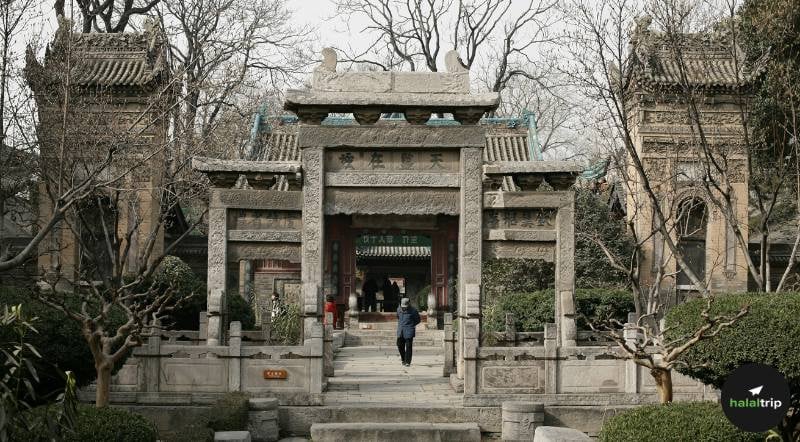
What makes the Great Mosque of Xi’an truly extraordinary is its breathtaking design, which eschews traditional Middle Eastern domes and minarets in favor of classical Chinese wood architecture. Spanning five interconnected courtyards, the complex is arranged like an imperial palace, guiding visitors through serene gardens, stone arches, and ancient bonsai trees.
The central minaret takes the form of a three-story wooden pagoda named the “Examining the Heart Tower”, while the grand prayer hall features tiled eaves decorated with intricate wooden carvings. Inside, Arabic calligraphic verses are carved alongside traditional Chinese floral motifs, creating a harmonious visual language where two distinct artistic traditions melt into one.
Step outside the wooden gates of the mosque and you immediately enter the lively labyrinth of the Xi’an Muslim Quarter, known locally as Huimin Jie. Here, history lives through the vibrant rhythm of daily street life. Narrow stone alleyways are filled with the rich aromas of simmering broth, freshly baked flatbreads, and aromatic spices.
Visitors can watch local artisans stretch wheat dough into long hand-pulled noodles, steam savory beef dumplings, or prepare yangrou paomo, a traditional local dish where unleavened bread is torn into hot, spiced lamb soup. It is a thriving neighborhood where centuries-old traditions are passed down through generations with pride.
The Great Mosque of Xi’an is far more than an architectural wonder; it is a living reminder that diverse cultures can weave together to create something enduring and beautiful. From the early merchant caravans of the Tang Dynasty to the bustling street markets of today, this place reflects a legacy of harmony, faith, and cultural exchange that continues to inspire global travelers.

