
The journey into the heart of Palawan begins in the darkness of the Puerto Princesa Underground River, one of the New Seven Wonders of Nature. As the small boat glides silently into the massive limestone chambers, travelers are greeted by a cathedral-like space where stalactites hang like intricate chandeliers and the only sound is the rhythmic drip of water against stone.
In this profound silence, the mind naturally turns to the Quran’s invitation to travel through the earth and observe, a call to witness the majesty of creation as a way of understanding the Creator. This cave system is more than a geological marvel; it is also a space that demands a contemplative presence.
While northern Palawan is famous for its emerald lagoons, the southern reaches of the province tell a story of human and spiritual continuity. Palawan is home to a significant Muslim population, with vibrant fishing communities whose lives are dictated by the tides and the times of prayer.
A visit to a local Muslim fishing village reveals a world where faith and livelihood are inseparable. Here, the traditional bangka boats are not just tools for trade, but vessels of a heritage that has survived for generations. Watching the community gather for prayer as the sun sets over the Sulu Sea provides a moving reminder that the Islamic identity of the Philippines is as enduring as the reefs that surround it.
Beyond the lagoons of El Nido, the waters of Coron offer a different kind of sanctuary found beneath the surface. The Shipwreck Reefs of Coron, where Japanese WWII vessels have rested for decades, serve as a moving testament to the passage of time. What was once a machine of war is now a vibrant coral reef, encrusted with life and teeming with schools of tropical fish.
Coron holds its history underwater, teaching observant travelers that time repurposes everything, eventually, into something beautiful. For visitors, swimming through these living monuments will be a reminder that even the most difficult chapters of history can be reclaimed by the persistent grace of nature.
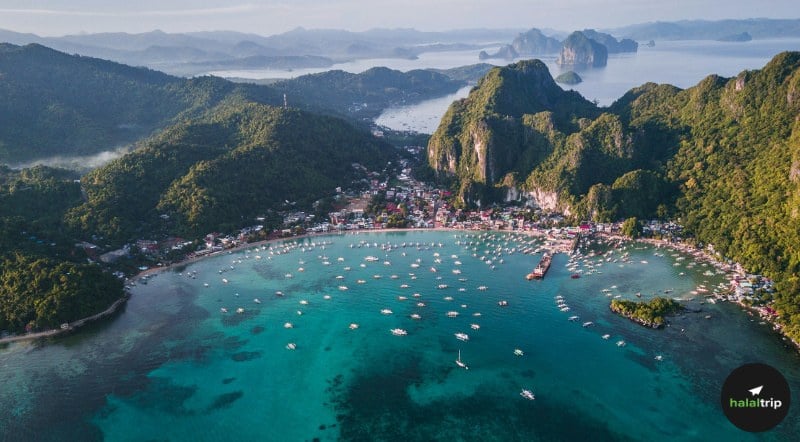
The towering karst limestone formations of El Nido create hidden lagoons that offer a rare form of natural privacy. These enclosed spaces serve as perfect outdoor sanctuaries for Dhikr and reflection, allowing travelers to find a moment of peace away from the distractions of the modern world.
This environment perfectly exemplifies CrescentRating’s RIDA framework for Halal tourism development (Responsible, Immersive, Digital, and Assured), specifically the Responsible and Immersive pillars. Palawan’s strict environmental conservation is a living expression of the Islamic principle of Khalifa, or stewardship, where protecting the beauty of the Last Frontier is seen as a sacred duty.
As the stars begin to emerge over the dark, unpolluted horizon of the lagoons, the realization becomes clear: Palawan is more than a mere destination. It is a sanctuary where the spirit finds a mirror in the stillness of the water.
In the silence of the underground river, the lessons of the sunken reefs, and the steadfast faith of the coastal villages, the traveler finds a profound sense of reconnection. By the time one leaves the "Last Frontier," they carry away more than just memories of emerald waters; they take with them a renewed spirit, having witnessed how nature, history, and faith coexist in a state of perfect grace.

