
Perched high above the modern city of Granada, glowing softly against the backdrop of the snowcapped Sierra Nevada mountains, sits the Red Citadel. Known in Arabic as Al-Qal'at al-Hamra, the Alhambra derives its legendary name from the reddish pink clay used to build its towering fortification walls. To walk through its archways is to step back into a golden era where art, faith, and science converged.
Built by the Nasrid Dynasty as the final sovereign Muslim kingdom on the Iberian Peninsula, the Alhambra stands not merely as a royal palace, but as a living testament to centuries of Andalusian mastery.
When Emir Muhammad I founded the Nasrid Dynasty in 1238, the political landscape of medieval Europe was shifting dramatically. As major centers of Islamic learning like Cordoba and Seville gradually changed hands, Granada emerged as the final refuge for Muslim scholars, poets, scientists, and master artisans.
Under successive rulers, particularly Yusuf I and Muhammad V in the fourteenth century, Granada transformed from a fortress outpost into a glorious royal city. The Alhambra grew into a complete ecosystem, encompassing royal residential quarters, military barracks, judicial courts, artisan workshops, and public baths. Within these defensive walls, Andalusian culture experienced its brilliant grand finale, concentrating generations of intellectual and artistic wisdom into a single hillside complex.
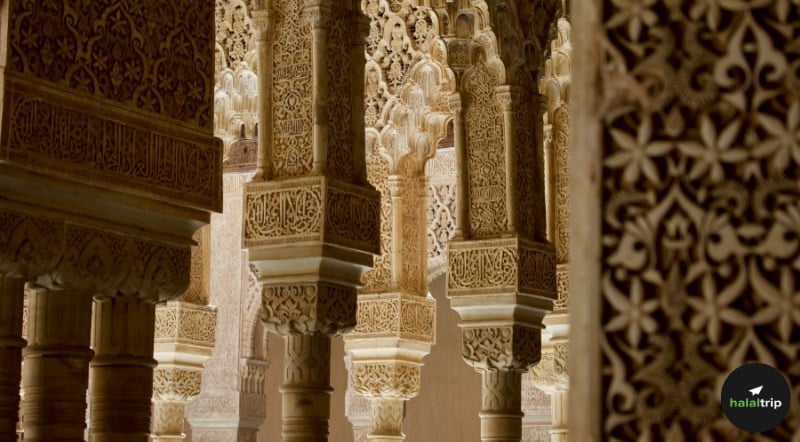
To enter the Nasrid Palaces is to witness stone transformed into delicate lace. Master craftspeople worked with plaster, wood, and tile, creating spaces designed to filter light and evoke a sense of weightless spiritual wonder. In the Palace of the Lions, intricate muqarnas vaulting hangs from ceilings like honeycomb stalactites, catching the shifting sunlight to create patterns of shadow throughout the day.
What makes the Alhambra unique is that its walls literally speak to those who wander through them. Thousands of calligraphic inscriptions adorn plaster archways, tile panels, and marble doorframes. Visitors will find poetic verses by royal court poets like Ibn Zamrak praising the beauty of the gardens, sitting alongside Quranic passages. Repeated relentlessly across almost every room is the famous Nasrid motto, which means there is no victor but God.
“Wa la ghaliba illa Allah”
This phrase served as both a royal decree and a humbling spiritual spell carved directly into the palace foundation, reminding every visitor once again of divine grace that walks with us.
Behind the ethereal beauty of the Alhambra lies an extraordinary feat of medieval engineering. Sabika Hill was naturally dry and barren, far above the water table of the surrounding valleys. To turn this arid hilltop into a lush paradise of royal gardens and flowing fountains, Nasrid engineers devised the Acequia Real, a complex six kilometer canal system.
By tapping into the Darro River high up in the Sierra Nevada mountains, engineers diverted fresh water along hillside aqueducts using gravity slopes. This continuous water supply powered the serene fountains of the Court of the Myrtles and supplied the cascading streams of the Generalife, the royal summer palace whose name originates from Jannat al-Arif, meaning the Architect's Garden.
Water in the Alhambra was never decorative; rather, it was a clear example of mastery in environmental design. The constant movement of bubbling fountains and reflecting pools cooled the summer air, while shaded courtyards channeled mountain breezes through open arcades, creating an effective natural air conditioning system that kept royal residents comfortable without modern technology.
The Alhambra remains one of the most sublime achievements in world history, bridging the material world with spiritual contemplation. Long after the last Nasrid ruler departed its halls, its carved poetry, clever water channels, and quiet court gardens continue to inspire awe in modern visitors.

