
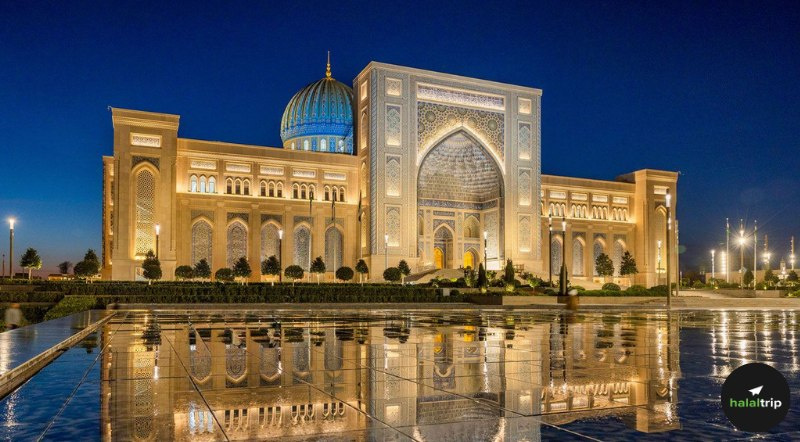
Photo of the Center for Islamic Civilization in Tashkent
The month of March 2026 will be remembered as the moment the Third Renaissance of Uzbekistan transitioned from a visionary blueprint into a breathtaking reality. Within a single historic week, the nation unveiled two monumental landmarks that redefine the landscape of Islamic heritage.
On March 17, the Center for Islamic Civilization in Tashkent opened its doors as a global hub for scholarship, and just two days later, the newly expanded Imam al-Bukhari Memorial Complex in Khartang officially reopened to the public. Together, these two pillars offer the modern Muslim traveler a journey that is as intellectually stimulating as it is spiritually profound.
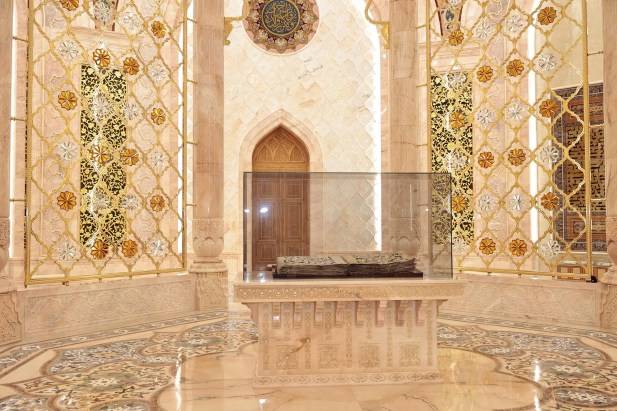
Photo of the Quran of Uthman | Image Credit: Islamic Civilization Center in Uzbekistan
Located in the historic Hast-Imam area, the Center for Islamic Civilization is much more than a museum. It is a 10-hectare testament to the Golden Age of Central Asia, where the lines between faith and science once blurred into a single pursuit of truth. The building itself is an architectural marvel; its 65-meter azure dome and four golden gates symbolize the unity of Uzbekistan’s regions.
Inside, the heart of the center is the Quran Hall, which houses the 7th-century Quran of Uthman, one of the oldest sacred relics in the world. However, the experience is firmly rooted in the future. Through the use of immersive exhibition formats and AI-powered holograms, the legacies of giants like Ibn Sina, Ulugh Beg, and Al-Khwarizmi are brought to life. Visitors can interact with digital avatars of these scholars, exploring how their ancient discoveries in medicine, astronomy, and mathematics continue to power our modern world.
The center also features Islam’s history. From entering, guests will be taken into a journey from the pre-Islamic heritage, the first renaissance, the second renaissance, and finally, to Uzbekistan’s visions for a new renaissance.
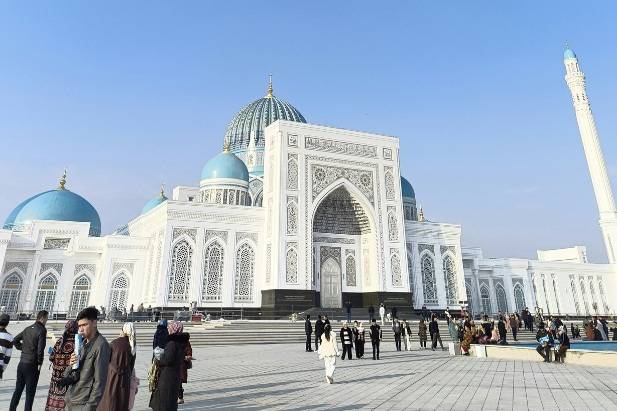
Image Credit: Misbah on Unsplash
While Tashkent feeds the mind, the village of Khartang near Samarkand provides the spiritual anchor. The Imam al-Bukhari Memorial Complex has undergone a transformation of staggering scale; what was once a modest shrine is now a 45-hectare spiritual city. Reopened ahead of Eid al-Fitr, the site is now capable of hosting up to 65,000 pilgrims at once, a significant leap from its previous capacity.
The silhouette of the complex is dominated by four towering 75-meter minarets and 14 azure domes that catch the soft light of the Zarafshan Valley. For travelers, the highlight is the new interactive museum composed of nine pavilions. These spaces use cutting-edge technology to trace the travels of the "Sultan of Muhaddith" from Bukhara to the furthest reaches of the Islamic world as he gathered the Sahih. To accommodate the influx of global visitors, a new mosque with a capacity of 10,000 people and a 15-hectare tourist zone has been established right next door, featuring Halal-friendly four-star hotels and family guesthouses.
For those visiting Uzbekistan in 2026, these two landmarks create a natural trail of living the Islamic renaissance. By taking the high-speed Afrosiyob train from the intellectual halls of Tashkent to the spiritual grounds of Samarkand, travelers can witness the full spectrum of the country's revival.
For Muslim travelers, a visit to the two destinations is more than just a checkbox on an itinerary. In a world where Islamic history is often underrepresented, the spaces offer a narrative of pride, intellectual rigor, and cultural beauty for every Ummah to feel at home. It provides a rare opportunity to stand in the very place where the foundations of modern science and spiritual jurisprudence were laid.
This journey will be a homecoming to a civilization that is once again asserting its place as a crossroads of knowledge and faith. Whether you are standing beneath the great dome in Tashkent or offering a prayer in the vast courtyard at Khartang, the message is clear. The Golden Age is not a thing of the past, but the very foundation of Uzbekistan’s future.
Banner image credit to Islamic Civilization Center in Uzbekistan

